For the Young Ones Coming Through: What Ron Davis Understood About the Dyslexic Mind
In 1949, a young boy sat squeezed into the corner of a classroom with a folded white handkerchief draped over his head. Ron later called it his label of unworthiness.
He wasn't allowed to leave the corner, and he couldn't hold on any longer. He wet his pants, then sat as still as he could, hoping the other children would be gone before anyone noticed and the name-calling started again. He had hoped that same hope many times before. When the room finally emptied, he whispered something only he was meant to hear, and a voice behind him demanded to know what he had said.
“I asked God not to make me sit in the corner anymore.”
That boy was Ron Davis. Decades later, he opened his first book, ‘The Gift of Dyslexia’, with that scene, and wrote that his childhood prayer was “the sole reason for this book.”
I first read those pages twenty years ago, when I bought the book to better understand someone I loved. They still move me deeply today.
Ron passed away this August, aged 84. Labelled “profoundly disabled” as a child, he became an engineer during the space race and later a sculptor. In 1980 he discovered the perceptual root of his own dyslexia, and everything he built afterwards came back to that little boy in the corner, and to making sure “young ones coming through” didn't have to sit there too.
Why Dyslexia Awareness Month matters this year
October is Dyslexia Awareness Month. Dyslexia Awareness Week runs from 5 to 11 October, and Thursday 8 October is Dyslexia Awareness Day.
Awareness is a good start, but it isn't what changed things for Ron. Understanding did. So this month I'm doing something a little different with these articles. Each week I'm unpacking one part of what Ron discovered about how a dyslexic mind works, drawing on his own words, so that by the end of October you have a clear picture of what's actually happening when a bright child struggles to read.
Dyslexia isn't damage, it's a way of thinking
When Ron was a boy, and for a long time afterwards, dyslexia was widely assumed to come from some kind of brain or nerve damage. Researchers produced theory after theory to explain what had gone wrong.
Ron came at it from the other direction. As someone who had lived it, he set out to understand what was happening from the inside, and what he found turned the old assumptions upside down. In his view, dyslexia isn't caused by damage to the brain or nerves, or by any fault in the brain, ears or eyes. He described it as “a product of thought and a special way of reacting to the feeling of confusion.”
That's a profound shift. If dyslexia comes from the way a person thinks, it isn't a fixed limit. It's a way of thinking that a person can learn to work with, given the right tools.
Verbal thinking and picture-thinking
Ron drew on a widely held idea that people think in two different ways.
Verbal thinking uses the sounds of words. It's the inner voice many of us hear as we think, composing sentences one word at a time, at roughly the speed of speech, around 150 words a minute.
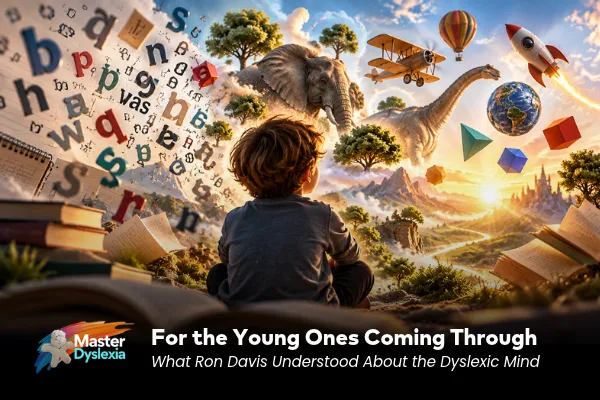
Picture-thinking uses images of meaning rather than words. The picture grows as each new idea is added, and Ron described it as far faster than verbal thought, possibly thousands of times faster. It happens so quickly that the thinker is usually unaware of doing it.
We all use both, but most of us lean towards one. Ron believed the children who go on to develop dyslexic difficulties are mainly picture thinkers during the years when those difficulties take shape, roughly between the ages of three and thirteen.
These pictures aren't only visual. Ron described them as more like three-dimensional movies involving all the senses, shifting and evolving as the thought develops. It's a remarkable way to think, and it sits at the root of the creativity and problem-solving so many dyslexic people are known for.
How picture-thinking shapes reading
Here's where the difficulty begins. A verbal thinker reads by hearing the words in their head. Many picture-thinkers don't. Instead, they build a mental movie as they go, adding the meaning of each new word as it arrives.
That works beautifully for a word like “elephant”, because seeing an elephant is seeing what the word means. It works far less well for small words like “the” and “and”, which have no natural pictures at all. Next week I'll explain what happens in a picture-thinker's mind when those non-picture words start to pile up, and why dyslexic learners struggle so much to read them.
Signs your child may be a picture-thinker
None of this is a diagnosis, and every child is different. Still, parents often recognise a picture thinker once they know what to look for.
Your child may understand something far more quickly when you show them than when you explain it. They might describe a scene from a film or a game in vivid detail, or remember exactly how to get somewhere after visiting only once. Many picture-thinkers love building or drawing, and can lose themselves in those activities for hours.
Reading can tell you something too. A picture-thinker might read “dinosaur” or “volcano” with ease, then stumble over “was” a moment later. Long spoken instructions can lose them part-way through, not because they weren't listening, but because there was no picture to anchor the instructions.
If that sounds familiar, Ron's life's work points to one conclusion: Your child isn't broken, and they're not lazy. Their mind works in a particular way, and that way comes with real gifts.
See it for yourself: WHO KNEW screenings this October
If you'd like to see these ideas brought to life, our free online screenings of WHO KNEW: Dyslexia is a Way of Thinking are a good place to start. The film follows dyslexic learners and the people who work with them, and shows dyslexia as a perceptual difference rather than a deficit.
➤ Tuesday 13 October, 7:00pm NZT / 5:00pm AEDT
➤ Tuesday 20 October, 7:00pm NZT / 5:00pm AEDT
These free online screenings include the film, a short introduction to Davis Dyslexia solutions, including the Davis Parent Power - Dyslexia course, and a Q&A session to follow.
I am co-hosting these viewings with my Davis colleagues Claire Ashmore and Nikki Palamountain, on behalf of the Davis Pacific facilitator team.
You can register for a free screening here.
Where to from here
Ron's answer to that prayer took him most of his life. For the young ones coming through now, it can start much sooner.
If you're seeing a picture-thinker in your own child and you'd like to talk about what a one-to-one Davis Dyslexia Mastery program could look like for them, I'd love to hear from you.
Ngā mihi nui,
Rachel
