Why the Smallest Words Cause the Biggest Trouble for Dyslexic Readers
Ron Davis was once a guest on a television show, invited to talk about the “positive” side of dyslexia. He listed a number of well-known people who were dyslexic, and the host responded warmly. It was amazing, she said, that all those people could be geniuses in spite of their dyslexia.
Ron’s reply has stayed with me ever since I first read it in ‘The Gift of Dyslexia’. The host had missed the point, he wrote.
“Their genius didn’t occur in spite of their dyslexia, but because of it.”
As Dyslexia Awareness Week draws to a close today, I think that’s the most useful thing awareness can offer. A list of famous names is lovely, but it doesn’t help a child at the kitchen table tonight. What helps is understanding why the same mind that sees the world so vividly can find reading so hard.
Last week I shared Ron’s discovery that dyslexia comes from a way of thinking rather than from some brain deficit or damage, and that many dyslexic people are picture-thinkers. This week I want to look at one of the most puzzling things parents notice, and what Ron’s work explains about it.
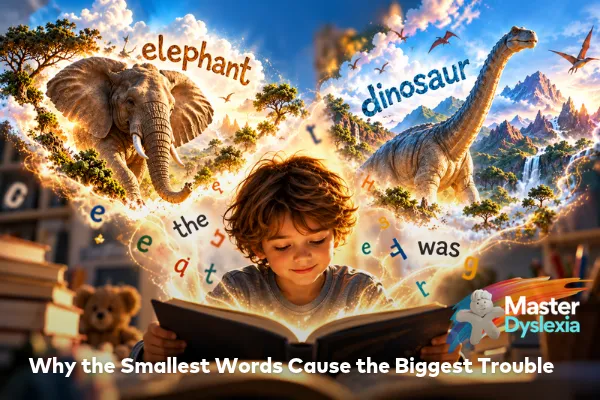
Why a dyslexic child can read “dinosaur” but not “was”
Many parents describe the same moment. Their child reads “dinosaur” or “helicopter” without a hitch, then stalls on “was” or “the” a line later, sometimes a word they read correctly on the page before.
It looks like carelessness, or a lack of effort. It’s usually neither.
How a verbal-thinker reads
A verbal-thinker reads with an inner voice. They hear each word as they go, small ones included, and the meaning of the sentence comes together at the end, once they’ve heard all of it in their head.
Ron used punctuation to show how much reading depends on that inner voice. In English, you often can’t tell whether a sentence is a statement or a question until you reach the full stop or question mark at the very end. A verbal-thinker simply holds the sentence in their head until then.
For a verbal-reader, words like “the” and “and” cause very little trouble. They know how the words sound, and the meaning of the whole sentence carries them along.
How a picture-thinker reads
A picture-thinker works differently. Rather than hearing the sentence, they build a mental picture of it as they read, adding the meaning of each word as it arrives.
For many words, that works beautifully. Ron’s example was “elephant”. If you know what an elephant looks like, seeing the picture is seeing the meaning. The same goes for words like “home” or “school”, and for action words like “fly” or “sleep” that a child has seen or done.
Now try it yourself with the word “the”. Close your eyes for a moment and picture it.
For most of us, the only picture available is the letters themselves. There’s nothing there to add to the movie.
The same is true of a surprising number of the most common words in English, such as “of”, “was” and “because”. These are the words a picture-thinker can’t picture. In the Davis Methods, they’re known as “trigger words”, because of the confusion they can trigger for dyslexic learners.
Why the smallest words matter most
Here’s the irony. The words that give picture-thinkers the most trouble are the ones that turn up most often. Pick up any early reader and count how many times “the” and “a” appear on a single page.
Each time one of those words comes along, the picture-thinker’s mental movie has nothing to add. Ron described the picture-making process stopping, over and over, with each stop bringing a small feeling of confusion. Next week I’ll explain what happens when those moments of confusion start to build, because it’s the key to understanding why reading can look like it's getting worse halfway down a page.
Why drilling sight words harder often doesn’t help
When a child keeps stumbling on small words, the natural response is more practice, often with flashcards and sight-word lists.
For a verbal-thinker, that repetition can work, because each round strengthens the sound of the word. For a picture-thinker, it can do the opposite. They may learn to recognise the shape of “the” for a while, but without a picture of what it means, the word stays empty. Each practice session can add another round of confusion, and another reminder that they’re getting it wrong.
It’s one of the clearest examples of something I see often in my work: hard work with the wrong method can make the problem worse. The child isn’t failing to try. They’re trying hard with a tool that doesn’t fit the way they think.
Signs to notice at home
You might notice your child guessing at small words, swapping “a” for “the”, or skipping them altogether. They might read “was” as “saw”, or lose the meaning of a sentence full of short words even though they read every long word correctly.
Many picture-thinkers understand a story far better when it’s read to them. The reader’s voice carries the small words, which leaves the child free to picture everything else.
One simple thing to try this week: when your child stumbles on a small word, resist the urge to have them sound it out again. Just tell them the word, and notice whether the trouble tends to come with words that have no picture. That noticing can change how you see the struggle, and often how your child sees it too.
In a Davis one-to-one programme, trigger words aren’t drilled. Each one is mastered by creating its meaning in clay, so the picture-thinker finally has a picture for a word that never had one. I’ll come back to how that works later this month.
Beyond awareness
This is what I mean when I say awareness isn’t enough. A child who keeps tripping on “the” doesn’t need us to know that dyslexia exists. They need us to understand what’s happening in their mind, so we stop mistaking a different way of thinking for a lack of effort.
See it for yourself: WHO KNEW this Tuesday
If you’d like to see Ron’s ideas brought to life, join us this Tuesday for a free online screening of WHO KNEW: Dyslexia is a Way of Thinking. The film follows dyslexic learners and the people who work with them, and shows dyslexia as a perceptual difference, a talent even, rather than a deficit.
➤ Tuesday 13 October, 7:00pm NZT / 5:00pm AEDT
➤ Tuesday 20 October, 7:00pm NZT / 5:00pm AEDT
The evening includes the film, a short introduction to Davis Dyslexia solutions, including the Davis Parent Power - Dyslexia course, and a Q&A session to follow.
I’m co-hosting with my Davis colleagues Claire Ashmore and Nikki Palamountain, Davis Dyslexia Facilitators, on behalf of the Davis Pacific facilitator team.
Ngā mihi nui,
Rachel
