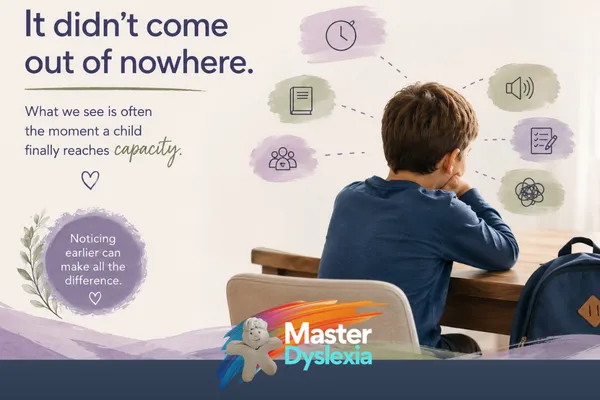
It Didn't Come Out of Nowhere
It Didn't Come Out of Nowhere
Recognising the Signs of Emotional Overwhelm in Children
“I don't know what happened. One minute everything was fine, and the next they completely lost it.”
It's something many parents will recognise.
A seemingly ordinary request is made.
Something small goes wrong.
A sibling says the wrong thing.
Homework comes out.
It's time to leave the house.
And suddenly, everything falls apart.
From the outside, it can look as though the reaction has come completely out of nowhere.
But often, it hasn't.
What we're seeing is the moment a child finally reaches capacity.
The Meltdown Isn't Always the Beginning
Last week, I wrote about why everyday requests can sometimes become battles.
A child who repeatedly says “no” isn't necessarily being deliberately difficult. Sometimes they're already overwhelmed, and one more demand simply feels like too much.
The same is often true of a meltdown.
We naturally focus on the moment everything explodes because that's the part we can see.
The shouting. The tears. Whatever refusal or anger comes with it.
But the story may have started hours earlier.
Perhaps even before the child walked through the front door.
Imagine a Cup Slowly Filling
I often think of overwhelm like a cup.
Throughout the day, little things are continually being added:
Getting ready for school
Remembering what needs to go in the school bag
Arriving somewhere noisy and busy
Following instructions
Trying to concentrate
Reading and writing
Remembering what the teacher just said
Changing from one activity to another
Navigating friendships
Trying not to make mistakes, or to look different
Holding emotions together
For a child who experiences learning, sensory input or everyday demands differently, some of those things may require far more energy than we realise.
The cup keeps filling.
Then they come home.
We ask them to put their shoes away.
And everything erupts.
It would be very easy to think: “All of this because I asked you to put your shoes away?”
But the shoes weren't really the problem.
They were simply the final drop into a full cup.
The Signs Can Be Easy to Miss
One of the most helpful things we can learn is what overwhelm looks like before a child reaches capacity.
And it won't look the same for every child.
Some become louder, others very quiet. Some start arguing about everything, others withdraw. Beyond that, watch for:
Increasing restlessness or silliness
Sudden difficulty making a simple decision
Heightened sensitivity to noise, touch or interruption
Saying “no” to things they would normally manage
Complaining that they're tired, hungry, or that something hurts
Struggling to do things you know they're capable of
It's easy to interpret these moments as “bad behaviour”.
But sometimes they're early warning signs.
The brain may already be telling us:
I'm running out of capacity.
“But They Were Fine at School”
This can be particularly confusing for parents.
A child may hold themselves together beautifully throughout the school day and then fall apart the moment they get home.
Naturally, parents wonder why.
If they managed OK at school, why can't they manage at home?
But home is often the place where a child finally feels safe enough to stop holding everything together.
They've spent the day concentrating and adapting, perhaps hiding how difficult some things feel.
Then they walk through the door and the effort catches up with them.
What looks like a completely disproportionate reaction may actually be the release of hours of accumulated pressure.
What If We Noticed Earlier?
This is where understanding emotional regulation can make such a difference.
We can't remove every difficult experience from a child's day.
Nor would we want to.
But we can become better observers.
We can start recognising the patterns.
When does our child usually struggle?
What happened beforehand?
Are certain transitions particularly difficult?
Does hunger make things worse?
What happens after school?
Are there particular environments that leave them exhausted?
What does their behaviour look like when they're beginning to reach capacity?
The more we understand an individual child's signals, the earlier we can respond.
Sometimes Less Is More
If we recognise that a child is already overwhelmed, it may not be the best moment for another instruction or another conversation about what they should be doing.
Sometimes they need less.
Less talking. Less noise. Less pressure.
Perhaps they need:
Something to eat
Some movement
Quiet time
Time outside
A familiar activity
Or simply a little space before the next thing is asked of them
This isn't about removing expectations.
It's about recognising when a child's brain is in a state where those expectations are unlikely to be successfully met.
There is little value in adding another demand when the cup is already overflowing.
Become Curious About the Pattern
When a meltdown happens, our natural instinct is often to focus on the trigger.
What happened immediately before it?
But I encourage families to look further back.
Instead of only asking: “What caused that?”
try asking: “What had been filling the cup?”
That question can reveal an entirely different story.
Perhaps the meltdown that appeared to be about homework actually began with an exhausting day at school.
Perhaps the argument over getting dressed followed a poor night's sleep.
Or the refusal to leave the house came after a morning filled with too many instructions and decisions.
When we understand the pattern, behaviour begins to make more sense.
And when behaviour makes sense, we can respond differently.
Before the Cup Overflows
One of the most important things we can give a child is the feeling that the adults around them are trying to understand, not simply react.
We won't always catch the signs.
There will still be difficult days.
There will still be moments when everyone reaches their limit.
But over time, we can become better at noticing what's happening beneath the surface.
The quieter signals. The growing resistance and sensitivity.
The signs that tell us:
This child is reaching capacity.
Because the meltdown we see at the end is rarely the whole story.
It didn't necessarily come out of nowhere.
We may simply have joined the story at the final chapter.
If this sounds like your household, a discovery call is a good place to start. We can talk through what's really going on, and whether a different approach could help.
Ngā mihi nui,
Rachel
