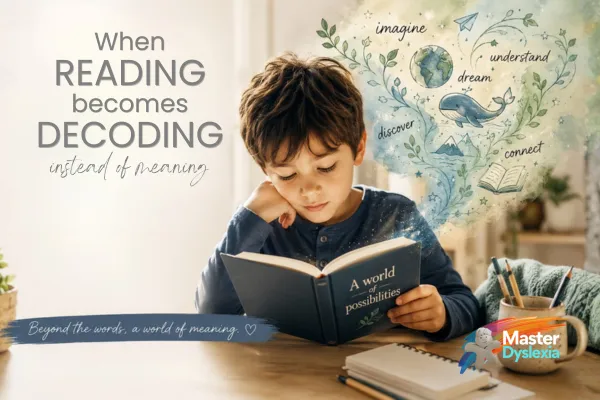
When Reading Becomes Decoding Instead of Meaning
Over the past few weeks, I've been writing about behaviours we often misunderstand.
The child who appears distracted. The child who seems to avoid learning. The child who works so hard to hide their struggles that no one realises just how much effort everyday tasks require.
Time and time again, the same lesson keeps emerging. What we see on the surface is rarely the whole story.
Lately, I've realised that the same is true when we think about reading.
We often assume that if a child can pronounce the words on a page, they are reading successfully. But is that really what reading is?
Reading Was Never Meant to Stop at the Words
Learning the relationship between letters and sounds is an important part of learning to read. Every child needs to develop an understanding of how written language works.
But reading has never simply been about recognising words.
Reading is about making meaning. It's about imagining new worlds and discovering something that wasn't known before.
When we become so focused on the mechanics of reading that meaning begins to disappear, we have to pause and ask ourselves an important question.
Are we teaching children to read, or simply teaching them to decode?
The Difference Matters
I've met many bright children over the years who work incredibly hard to sound out every word on the page. They're concentrating with everything they have, working through each sound and trying to hold on to every strategy they've learned.
By the time they reach the end of the sentence, they've used so much mental energy decoding the words that there's very little left to understand what they've just read.
Imagine trying to enjoy a movie if you had to stop every few seconds just to work out what each frame meant before moving to the next. You would eventually reach the end. But would you really have experienced the story?
Reading can feel exactly like that for many children.
Intelligence Has Never Been the Issue
One of the greatest misconceptions about reading difficulties is that they reflect intelligence. They don't.
Some of the children I work with are extraordinarily thoughtful. They ask insightful questions. They notice patterns that others completely miss. Their imagination is remarkable.
Yet when reading becomes an exhausting exercise in decoding, those strengths can easily remain hidden. The effort required to recognise the words often masks the understanding that sits underneath.
Reading Should Spark Curiosity
Think about the books that have stayed with you throughout your life.
It probably wasn't because you admired how accurately you pronounced every word. You remember them because they made you feel something. Perhaps they made you laugh. Perhaps they introduced you to an entirely new way of seeing the world.
That is the real purpose of reading. Not simply to say the words correctly. To connect with ideas. To discover possibility.
When children experience reading only as hard work, we risk taking away the very thing that makes reading worthwhile.
Keeping the Bigger Picture in Mind
There are many conversations taking place at the moment about how reading should be taught. Parents, educators and specialists all want the same outcome. Children who can read and understand with confidence.
My hope is that, whatever methods we use along the way, we never lose sight of where we're trying to arrive.
Because success isn't measured only by whether a child can sound out the words. Success is measured by whether those words create understanding, whether they inspire curiosity, and whether they help a child discover confidence in themselves as a learner.
Looking Beyond the Page
Just as behaviour tells us more than what we first see...
Just as masking reminds us that appearances can be deceiving...
Reading deserves the same thoughtful approach.
When a child is struggling, perhaps the question isn't simply, "Can they read the words?"
Perhaps we also need to ask, "Do those words have meaning for them?"
Because reading was never meant to be an exercise in getting every sound exactly right. Reading is about understanding. It's about imagination. It's about connection.
And perhaps most importantly, it's about opening a door to a lifetime of learning, curiosity and possibility.
When we keep that bigger picture in mind, we don't simply teach children to read. We help them discover why reading matters in the first place.
If your child can sound out the words but the meaning isn't landing, there's a reason, and it can be addressed. A Davis Dyslexia programme works with how your child's brain actually processes language, not just the mechanics on the page. [Book a free discovery call] to talk through what's really going on for your child.
