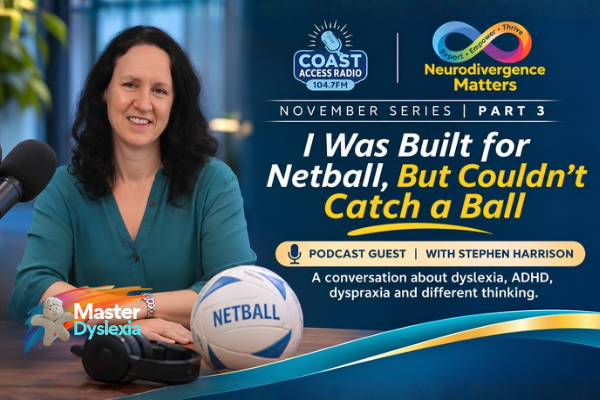
Rachel Barwell Featured on Neurodivergence Matters Podcast
Neurodivergence Matters: Interview with Rachel Barwell
Episode: Dyslexia, Different Thinking, and the Davis Method
Host: Stephen Harrison, Thrival Coaching
Guest: Rachel Barwell, Master Dyslexia
Broadcast: Coast Access Radio, 11 November 2026 (about 30 minutes)
link to recording - https://files.leadconnectorhq.com/file/6af8d802893246071f8304d0/neurodivergence-matters-20261111-interview-with-rachel-barwell-2.mp3
This transcript has been lightly edited for readability.
[00:10] Stephen: Welcome to Neurodivergence Matters. I'm your host, Stephen Harrison from Thrival Coaching. Today is a real treat, an interview, and I've got with me Rachel Barwell. She's a founder and licensed Davis Dyslexia Facilitator, working with the Davis Dyslexia Association. Welcome, Rachel.
[00:34] Rachel: Thank you, Stephen. It's great to be here.
[00:39] Stephen: Tell me a little bit about yourself, in terms of why neurodivergence matters to you.
[00:46] Rachel: Over 20 years ago, I had a partner who we found out was dyslexic. And I found a book, one of those books that kind of jumped off the shelf in the bookstore, called 'The Gift of Dyslexia', by Ron Davis. I knew nothing about the field at the time, and I was fascinated by it. It helped him and me understand what had been going on all his life, and some of the difficulties he had.
I was doing something completely different with my life at the time, but I thought one day I might come back to this.
Then I was working in the education space, with students in prisons and then in the wānanga space. Lots of hardworking, bright, capable young people who really struggled with maths and reading and writing. They'd learn something on a Friday, and by Monday they'd seemingly forgotten it. They struggled to take all of those amazing ideas and put them down on paper for an essay. I'd often get those last-minute Sunday phone calls: "Rachel, I've got this essay due..." They had all the thinking going on, and they'd even done some research, but they could not bring all those ideas into a coherent format for an essay without a lot of help.
I went away to find out more about this, because I thought there was something more at play than just general difficulties. I did some study at Waikato University on adult literacy and numeracy, and confronted some of my own issues around maths. I came away with more information, but not what I could see were practical, different solutions from what I already had in my kit of tools.
Then one day I ran into a colleague who had trained in the Davis Method. I asked her, "What's different about that to everything else that's out there?", because I'd been in the adult education space a long time. And she said, "Well, Rachel, it really works, and it really lasts." I was interested in both of those things. She had also worked with adults as well as children and teenagers, and that was of interest to me too. So I trained in 2018, became a licensed facilitator in 2020, and I've been facilitating here in the Wellington region since then.
[03:16] Stephen: And you've also got a bit of a personal connection with neurodiversity as well.
[03:22] Rachel: Yes. In the journey of training, which took me about two years, I discovered my own ADHD, and my own dyspraxia, which is the clumsy neurodiversity. So I'm 5'10", built for netball and basketball, and couldn't catch anything until I was about 50. People were puzzled at school: I looked like an athlete, but didn't have any of the helpful attributes to play team sports. I spent a lot of my life having minor and not-so-minor accidents, and just general clumsiness, bumping into furniture and things like that. I never understood why until I did this training, and found there was a neurodiversity aspect to that.
The ADHD explanation was really interesting, because I've lived life on full max for a lot of my life: really flat out, working hard, playing hard, trying to do lots of things all at once. While that's been exciting, it's also had downstream effects around fatigue, and often becoming a bit unreliable, like over-committing and not being able to follow through on things. Or being generally considered a bit over the top in conversations: "How can you have so much enthusiasm for these things?" So again, it filled a lot of gaps for me, and gave me some new tools to help me manage those two interesting aspects of my brain.
[04:53] Stephen: And if it's anything like me, it brings an element of relief, knowing that's what it is.
[05:03] Rachel: 100%. Not explaining away my clumsiness, but knowing that it's a real thing. It's not just me being inattentive, or lazy or something like that. It was a real issue, and I've got tools now to help me with it. So I have far fewer accidents, and much more confidence. I can now play sport and enjoy it. I enjoy shooting hoops, which was just not possible before.
[05:36] Stephen: And now you're bringing some of that learning to other people as well.
[05:41] Rachel: Yes. I really enjoy working, particularly with young people who have some form of dyspraxia, because it can be very isolating socially. You think, "Oh, it's just sport", but actually much of our life in this country is centred around sport. If you don't feel you're participating, or you don't feel you're contributing well as a team member, it's a bit difficult. I kind of isolated myself. I took up the piano and swimming, as a way to have another activity to succeed at, and they were very fulfilling, but they're quite solo affairs compared to playing netball or something like that.
I just love it when I have a client who knows those issues, and learns to ride bikes and scooters, and participate fully in life as a young person. I think that's so important for our wellbeing, our socialisation, and our confidence going out into the world.
[06:46] Stephen: Couldn't agree with you more, and we'll explore that a bit more later. But firstly, what connected us initially was you sending out a press release about the passing of Ron Davis. So perhaps you'd like to share a little bit about Ron, and what made him so special.
[07:06] Rachel: Ron was born non-speaking autistic and dyslexic, in the 1950s, in the United States, in Utah. At the time there was so little understanding of these things at school, and he experienced a lot of what we'd now call educational trauma. He was deemed unable to be educated, and his account of his schooling was pretty grim, quite frankly.
He started to emerge from what they call the void of autism when he started making things in red earth clay in his backyard as a child. The things he wasn't allowed to have, he would make. Eventually he got around to making the letters of the alphabet, and when he did that, he realised that the alphabet strip around the classroom wall suddenly stopped moving, and he could actually interpret it. By the time he was 20, he had taught himself both alphabets and how to read at a rudimentary level, through using clay.
But it wasn't until he was 38, living and working as an artist, that he discovered that when he was at his artistic best, he was at his dyslexic worst. He couldn't write down the process he was using to do his art, and it was a light-bulb moment for him. He got interested in why: if that happens, but it's not consistent, why does it happen? And he discovered this phenomenon called perceptual disorientation.
All of us do it, whether we're neurodivergent or not. But it seems when we're neurodivergent, we're more likely to disorientate, both creatively, which is what he was doing when he was creating art (he was a sculptor), and inadvertently, when things interfere with our actual perception of how things are. That can happen when you're dyslexic. Your disorientation can get triggered by 2D symbols, because your picture brain, your 3D brain, is trying to interpret 2D symbols, which all languages are written in.
So that's his discovery. And when he figured out how to control it, he read a book in a weekend. Then he started working with the people around him, many of whom were neurodivergent, being artists. He eventually founded the Reading Research Council to discover more about this and develop methods to train other people, and eventually created the Davis Dyslexia Association International, to train professionals around the world in these methods. Then there was the work everyone says he was really born to do, which is the autism work, through the Ron Davis Autism Foundation. He discovered it wasn't just dyslexia that his methods helped with. They helped with ADHD and maths, and then the autism work, which is just remarkable, because it allows people to come out of the non-speaking aspect of autism and be able to function in the world. He talks in one of his books about always wanting to be like "real people".
[10:42] Stephen: Well, isn't that something we all want? I know for a lot of my growing up it was like, I'm the odd one, sitting on the outside looking in, going, "Why can't I be like everyone else?"
[10:56] Rachel: That was exactly his experience, and because of where it started, it was quite an extreme experience. When I see the results of people who have gone through the Davis autism work, it's life-altering. People are able to go out and function in life, and participate in holding down jobs and study, which was not necessarily possible for them before. So I do see why that really is his ultimate contribution.
But I think his biggest contribution, in the space of dyslexia and neurodiversity in general, is that he shifted the perception from neurodiversity as a disability, to it being a set of talents and gifts.
Stephen: Superpowers.
Rachel: Yes, superpowers. He used the word gift a lot. He said it's a gift, and we can use these gifts to do great things in our life, and use them to help us learn to do the things we find difficult. For dyslexia, that's reading, writing, spelling and understanding text. That's what he was most known for in the world, I think: shifting that narrative, so people can stop feeling bad about their neurodiversity, start celebrating their strengths, and leverage those strengths to help with the bits that are tricky.
[12:40] Stephen: In my understanding, he was a sculptor, he'd done a lot with neurodivergence, and he was an engineer.
[12:49] Rachel: Yes, his early career was in engineering. He ended up working really as a mechanical engineer, then got into working on rockets with the space race. It was his neurodiversity that enabled him to do what he did. In his autobiography, 'Dummy: The Autobiography of a "retard"', he talks about that whole journey: his ability to look at systems and see how they're meant to work, and how to create them and troubleshoot them. That got him into that industry, right at the early stage, and it was quite an exciting time. Then he moved on to being an artist and other things.
[13:43] Stephen: And it's precisely the skills used as an engineer, problem-solving and understanding systems, that enabled him to work out what actually worked for himself, and then apply it to others.
[13:59] Rachel: Yes. He used that thinking to say: "If the experience of disorientation is inconsistent, it's not permanent, and that means the brain is not damaged. Something occurs that causes it to disorientate," and that's what he got really fascinated in. "If that happens, there must be something that causes it. What can we do to deal with that cause, and what can we do to control that phenomenon, particularly when we want to do things that don't necessarily work with our 3D, picture-thinking brain?"
That was his early discovery, and then he developed the systems to deal with it. The Davis Methods are a series of tools and strategies to help with disorientation: to stop it when it happens, and prevent it happening in the future, so you can prepare your brain to read and write. And also to master the symbols of our language, so that they don't trigger those disorientations going forward. So eventually a neurodivergent person can read with far fewer problems than they used to have.
[15:28] Stephen: So he not only developed a method, he also created the organisation. Tell us a little about that and its mission.
[15:39] Rachel: Its mission really is to support neurodivergent people to use their talents to the best of their abilities, and to overcome whatever challenges they have with their neurodiversity.
With dyslexia, that's challenges with reading, writing, spelling, understanding text and recalling it. So many people I've worked with can read something quite well, but can't tell you about it the next day, because it's just gone. It hasn't gone into their picture-thinking brain, their 3D brain.
It's also helping people with ADHD, who often have issues with attention and self-regulation. Sometimes their energy is too much, sometimes it's too low, and they're not able to focus and pay attention when they need to, for learning or for work. They might have difficulty in social situations, knowing when to take turns in a conversation or an activity. Or they may have difficulty taking creative ideas and bringing them into reality. I meet so many people with amazing ideas who can tell you all about them in fine detail. Then you say, "Okay, so what's the next step you're going to take?", and they just can't seem to start, or they get started and can't seem to finish executing those ideas. So we work a lot with that executive functioning process.
Then in the autism space, depending on where someone is on the autism spectrum, it's working with life concepts to help with the process of individuation: helping a person understand ideas like cause and effect, change and consequence, being able to fit into a world of time with a solid understanding of time, being able to sequence things, and creating order from disorder. Life presents us with disorder, and how do we organise things?
[17:49] Stephen: I'm imagining people listening and going, "Oh my goodness, that sounds awesome. That would make a massive difference for my child."
[18:06] Rachel: Yes, it is. I've had children who had so many difficulties organising themselves, and when we started applying those tools, they were able to self-regulate. They weren't bouncing around all the time, and they were able to focus.
I had one young client, aged 14, who was always anxious about time, but she had no concept of time. She was always asking her family: "How long is this going to take? When are we going to stop? How long is the movie going to be?" When I worked with her around the concept of time, I got her to estimate how long it would take to make a cup of tea, for example, then make it and time it, so she had a real-world register for that. Then I gave her an assignment. I said, "When you go home, before you start the journey, estimate how long it's going to take to get home. Then record it, and tell me tomorrow." That anxiety just disappeared for her, because suddenly she had a tangible connection to the concept of time, and could estimate how long whatever the activity was would take. Her family said she was a different child.
[19:31] Stephen: Not just the mental anchor of recording it, but also the physical anchor of what it looks like, and that starts to bring all the different aspects together.
[19:43] Rachel: Yes. And I think it stops that thing a lot of young people do in their teens, when they have assignments due on Monday, and then it's the screaming rush on Sunday afternoon: "I've got this big science assignment, I have to write this essay", and everyone's in a big panic trying to get it done. That's because they're missing that life concept of time, which gives us the capacity to plan. If we don't have a solid grounding in time, it's very hard to plan our work, get started, and get it done in a timely fashion. So then you have all that last-minute stuff happening, which is very stressful for families.
[20:20] Stephen: That made me smile, because it sounds like the average university student.
[20:24] Rachel: Well, it doesn't get any better, does it? It might start out at an eight-year-old level, with homework you haven't done and are trying to do before school on Monday, through to the stressful teenage years of exams and essays, through to university. I've worked with some university students, and that's often one of their biggest challenges, depending on their neurodiversity: being able to plan out their work and settle to do it in a systematic way, so there isn't a huge rush and pulling all-nighters.
That was my habit before I knew I had ADHD, and that I could actually allocate time and manage it and estimate it a lot better. I was famous for pulling all-nighters as a student, and as a young person in the workforce, to meet a particular deadline. You can do it, but after a while you start to burn your brain out, and it's not sustainable.
[21:37] Stephen: I can totally relate to those all-nighters. And I think the thing to highlight is that anybody can be like that, but when you're a neurodivergent person, it tends to be more aggravated, with less choice. It's a question of helping that person see a much bigger picture, and gain some options they can work with.
[22:01] Rachel: Yes, it can really seem like a compulsion, like you have no option: "The only way I'm going to get this done is to do that." And yet there were options further back, but for some reason we didn't choose them, and we wound up in what I call the pile-up at the end of the week, with far too many things to do and not enough time. So you extend into night-time work, or start very early. Ultimately, if you do enough of that in your life, I find it contributes to a sense of burnout, or actual burnout, which is very costly for people.
[22:41] Stephen: Yes, and I've done several episodes on burnout recovery and those sorts of things. I can totally relate to that, from my own experience.
[22:48] Rachel: I see a lot of young people getting attracted to working in technology, and there's lots of very exciting work in that space now. But those technology companies can be very demanding in their expectations. I've said to the young people I work with, you want to start constructing a life now where you're not burning the candle at both ends all the time, so you can sustain a career in this industry, and sustain your wellbeing and the other aspects of your life.
[23:45] Stephen: Some of that technology is really helpful, and some of it is just so cluttered, and so unhelpful to a neurodivergent brain. It's quite amazing.
[23:47] Rachel: Yes. I come across a lot of young people who are gamers, and adults for that matter, and gaming often goes hand in hand with ADHD, I think. It's a very compelling activity. I've read some research, which is rather scary, that the companies who build those games have done a lot of study of psychology, and how to engage the brain and keep it engaged for as long as possible, because that's the commercial model. The more you're in the game, watching the ads and all the things that come with it, the more money they make. But it's at the cost of the health and wellbeing of the people who are compulsively gaming.
Without getting on a soapbox about it, I always say to young people: "Make sure you have other things going on in your life as well." There's a sort of unreality to the gaming world. It's fun, I can see that, but it doesn't provide you with the experiences of real life. If you're playing a car racing game and you crash, you just click a button and play again. There's no real-life consequence.
[25:12] Stephen: No, and it isolates you even more from learning the lessons you need to actually engage with life.
[25:17] Rachel: Exactly. Then you go out on the road and think you can behave the way you did in the online game, and you can't. The consequences are really severe. That's one of the things I see: a lot of young people with ADHD don't have a strong grounding in real-life consequence. And when I say consequence, I don't mean the punishment aspect. I mean, if you do something, something else will happen, and if you don't do something, something else will happen. And we have a say in that world of consequence, if we choose to take it on.
So that's one of the big things I see with young people coming through. I'm not bagging gaming per se, but it's one of those activities where we have to be very mindful of how we engage our brains, and how our young people use their brains in that space, and try to find other activities that bring them more into the real, tangible world.
[26:28] Stephen: We're now moving into the last couple of minutes. What would you like to leave as your message?
[26:38] Rachel: Really, for families of neurodivergent people: recognise their talents and their abilities, and celebrate and support those. Be the best advocate you can for them in the education space, so they get appropriate support for their neurodivergence. And know that there are real-world solutions for the challenges of neurodiversity, whether that's dyslexia, attention and focus with ADHD, maths issues, or the whole space around autism. There are real, practical solutions available.
Don't wait and hope that the young person will grow out of the challenge. They won't. They're neurodiverse, they have those brains for life. But it's how do we learn to use them in the most powerful way, and thrive in our lives? As you speak about a lot on your podcast, it's about thriving, and maximising the amazing talents we do have, and being able to navigate the challenges in a smoother way, so they're not barriers to progress.
A final example: I worked with a law student last year who was about to quit law. She was getting Cs for her academics and As for her practicums, and she was sent away to try and resolve the dyslexia that was holding her back. We worked together, and she got As and Bs in her final semester, went on to do her bar exams, and is now working as a young lawyer in her hometown. It's really transformed what she saw as the likely outcome for her life.
That can happen at any age. But I always say, the sooner you identify it and do something about it, the more options a young person has to really enjoy learning, enjoy life, and feel good about themselves, rather than think they're dumb or stupid or not academic, or not capable in some way. It's quite the opposite.
[29:02] Stephen: Thanks very much, Rachel. I very much appreciate you taking the time. For everybody else out there, check the website. We'll have some links there to help you find out a bit more about the Davis Method, and about Rachel. This is Neurodivergence Matters. I'm Stephen Harrison from Thrival Coaching. Ka kite.
[29:32] Announcer: This episode was produced at Coast Access Radio with support from NZ On Air Irirangi Te Motu. You can catch this and other podcasts online at accessmedia.nz, or search Coast Access Radio on Spotify and Apple Podcasts.
