There's No Off-the-Shelf Approach for a Dyslexic Brain
If your child struggles with reading, writing, spelling, focus, or managing their behaviour at home and school, you've probably already tried extra practice, a tutor, or more worksheets. Sometimes some things help a little. Often, the same struggles keep resurfacing in a different form.
My work is grounded in the Davis Methods, created by Ron Davis, widely acknowledged as a genius for developing this approach to dyslexia, dyscalculia, ADHD and autism. But how I use those methods, and how we work together, is shaped entirely around the individual person and their family sitting in front of me. It's tailored, not templated. And the goal, always, is that eventually you won't need me at all.
Sometimes the Learning Doesn't Look Like Learning
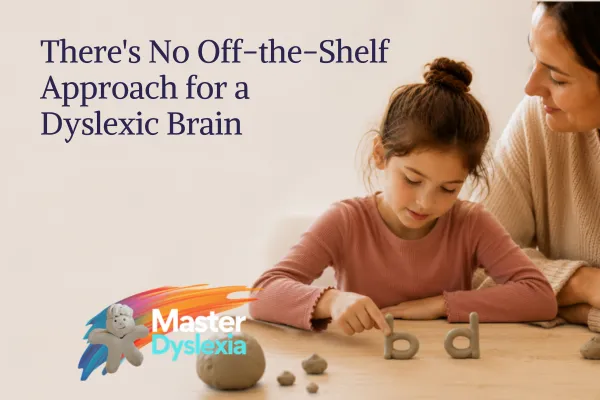
A child won't be sitting quietly at a desk while I work through a predetermined lesson with them. We will use modelling clay, balancing exercises, or head outside to kick or throw a ball. We might explore one of their particular interests, like breeds of foxes or drift-car racing (I kid you not), through reading and writing.
One young client, a teenage boy, had already changed schools once due to disengagement, yet was still struggling in his English classes at his new school. He was fascinated by drift-car racing and was an avid online gamer, so I built his program around what he already loved. We found articles about drift-car racing for him to read, and he wrote a two-page story about becoming an apprentice drift-car racer. His family have shared that his results have dramatically improved, and he's far more engaged at school.
That's not me stepping outside the methodology. That's using it with the person in front of me in mind.
Tailor-Made, Not Off-the-Rack
Think of it like the difference between a suit off the rack and one that's tailor-made. Off the rack, the principles are sound, and for some people, it fits well enough. Tailor-made starts with you, your shape, how you move, what you need it for. The fundamental principles haven't changed. What changes is how they're applied to fit the individual.
That's also why this isn't tutoring. A tutor can help a child consolidate reading, spelling or maths, and one to two years of weekly tutoring can produce real academic improvement. But it doesn't usually change a dyslexic person's underlying tendency to disorientate on symbols, which is the root cause behind the mistakes, hard work and frustrations with reading and writing in the first place.
A Davis program works at that deeper, neurological level instead. It's built around one intensive week with me, followed by a year of the client's own follow-up mastery work, supported by three review sessions along the way.
The Goal Is Always Bigger Than the Program
Ultimately, I don't want someone to need me forever. I want them to develop the tools to become increasingly independent, to recognise what's happening when something becomes difficult, and to know how to respond. I want them to reach the point where they think, “I know what tools I need to use here to help myself.” That's incredibly powerful, because we're not trying to change who they are. We're helping them understand how their own brain works, and giving them tools that work beautifully with it.
Why Nothing “Standard” Was Ever Going to Work
You've probably already tried a fair few things, and watched the same struggles resurface in a different form. That's not because you or your child didn't try hard enough. It's because a standard learning program was never going to address what's actually going on underneath, at the neurological level.
When asked, “What does working with you look like?” I like to say, “It totally depends on the person.” Because there isn't a standard dyslexic child or adult, and there shouldn't be a standard way of supporting them. The methodology, the framework, and the powerful tools are all there. But the experience is shaped around the individual and their family.
At Master Dyslexia, the methodology provides the foundation. But the person always comes first.
If you've ever wondered what a tailor-made neurodivergent learning approach could look like for your own child, a discovery call is a good place to start.
Ngā mihi nui,
Rachel
