What Actually Happens in a Davis Dyslexia Program?
One of the questions parents often ask me is very simple: "What will my child actually do in a Davis Dyslexia Program?"
It is an understandable question. If your child has already had years of support, extra reading practice, tutoring, intervention or time out of the classroom, you want to know what will be different this time. You want to know what the days will look like, whether they will be sitting at a desk doing more reading and writing, working through worksheets, or being asked to practise the very things that have already caused them frustration. And perhaps most importantly, what could actually change.
The answer begins with understanding that a Davis Program is not simply more of the same.
We begin with the learner, not the difficulty
Every dyslexic learner who comes through my door is different, with different strengths, different challenges and different experiences of learning. Some arrive frustrated and anxious. Some have become very good at hiding the things they find difficult. Others have simply decided that reading, writing or school are not for them.
So we don't begin by handing them a standard set of exercises. We begin by understanding them, how they think, what causes confusion, what happens when they become stuck, and what they are already doing incredibly well.
This matters because Davis work is built around the strengths of the dyslexic thinking style, rather than trying to force the learner into a way of learning that has repeatedly failed them.
It is hands-on, active learning
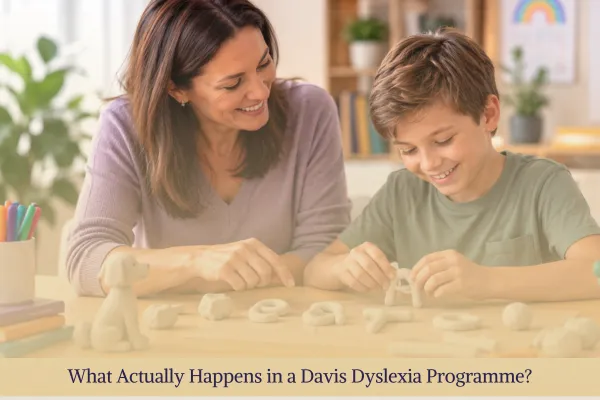
This is often the part parents don't expect. A Davis Program does not look like the traditional picture of literacy intervention. There is movement, conversation, clay and exploration, and moments when a learner stops, notices something, and suddenly understands why something has been difficult.
Clay is particularly powerful because it allows an idea, letter, word or concept to become something tangible. Instead of information existing only as marks on a page, the learner can create it, see it, touch it, move it and understand it in three dimensions. For a visual, creative thinker, that can make an enormous difference.
In last week's article, I wrote about how Ron Davis himself discovered the power of creating letters in clay. What began as his own way of making sense of something confusing eventually became part of the approach we use with dyslexic learners today.
But clay is only one part of the program.
Learning how to recognise and resolve confusion
One of the most important parts of Davis work is helping learners recognise what happens when they become confused or disoriented. For many dyslexic learners, that moment happens incredibly quickly. A letter, word, symbol or instruction does not make sense, confusion increases, the learner tries harder, and the harder they try, the more difficult the task can become.
Over time, this can affect far more than reading or spelling. It can shape a child's confidence, their behaviour, and how they see themselves as a learner.
During a Davis Program, we give the learner tools to recognise those moments and regain control of their focus. That shift matters because they are no longer completely dependent on somebody else correcting them or telling them what to do. They are developing tools they can use for themselves, independently.
So what does a day actually look like?
It doesn't look like hours of sitting still and struggling through worksheets. The work is varied and paced around the learner. We might work with clay, explore letters, words or concepts, read, or look at what happens when confusion appears and practise tools that help regain focus, with breaks, movement and discussion built in throughout.
Importantly, I am continually watching the learner, whether they are engaged, whether they are becoming overloaded, whether something has clicked, and whether we need to approach something differently.
A Davis Program is intensive, but it is also highly individualised. We are not trying to push a learner through a predetermined set of tasks simply because the clock says it is time to move on. We are building understanding.
What change are we looking for?
Parents sometimes ask whether they should expect a small improvement or something more significant. My experience is that the changes can be profound. Of course, every learner is different, and no two programs unfold in exactly the same way, but the aim is not simply to help a child get a few more words correct on a reading test. We are looking for something much deeper.
We want the learner to understand what has been happening for them, to have practical tools they can use, and for reading and writing to begin making more sense. And perhaps most importantly, we want to change the story that many dyslexic children have begun telling themselves: "I can't do this." Because very often, they can. They simply haven't yet been shown how to work with the way their mind naturally operates.
Some of these same tools also find their way into the classroom through Davis Learning Strategies, though that pathway still looks different depending on where you are.
Sometimes you need to see it
Davis work can be difficult to explain because it looks and feels different from many traditional approaches to dyslexia support. You can read about clay modelling, about orientation, disorientation and the dyslexic thinking style, and about learners whose relationship with reading and learning has changed. But sometimes the best way to understand it is simply to see it happening.
That is one of the things I love about the documentary WHO KNEW: Dyslexia is a Way of Thinking. It gives parents, educators and dyslexic adults an opportunity to see the Davis approach in practice and to hear directly from people whose experience of dyslexia has shaped their lives.
For a parent wondering what this would actually look like for their child, watching the film is probably the closest thing to sitting beside me during a program and seeing the process unfold.
The final online screening this month is on Sunday 20 September, 4pm to 5.30pm NZT (2pm to 3.30pm AEST). It includes the film, a short introduction to Davis Dyslexia solutions, including the Davis Parent Power - Dyslexia course, and a Q&A session to follow.
Book your place here.
Ngā mihi nui,
Rachel
