What We Heard on Sunday (and Where It Can Go Next) | Master Dyslexia
Last week I shared what actually happens during a Davis Dyslexia Program. I wanted to take away some of the mystery around what a learner experiences, what the days can look like, and why the Davis Methods can feel so different from the support many dyslexic learners have experienced before.
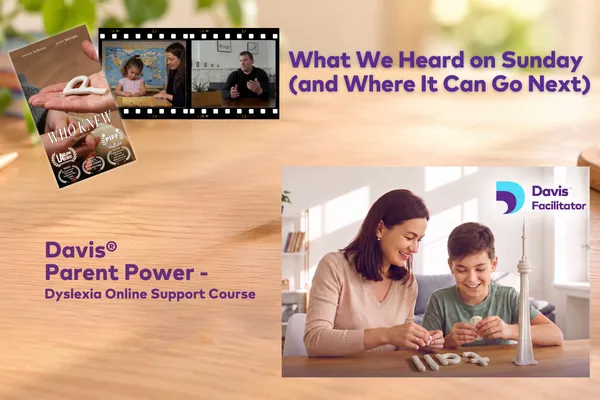
On Sunday, I had the opportunity to watch people discover that difference for themselves. We held another online screening of WHO KNEW: Dyslexia is a Way of Thinking, and once again I was reminded that sometimes seeing and hearing other people's experiences can shift our understanding in a way that explanations alone cannot.
Before the film had even started, one attendee introduced himself in the chat. He was 60 years old. Throughout his entire school life, he had been told he was stupid and lazy.
I found myself thinking about just how long someone can carry those words. Not because they were true, but because at the time nobody understood that the way he processed information and experienced learning was different.
When the way we see dyslexia changes
One of the things I hope people take away from WHO KNEW is a different way of looking at dyslexia, not simply through the things that can be difficult, but through an understanding of the thinking style behind them.
Towards the end of Sunday's screening, another attendee wrote:
"I love the framing of this being a talent and a gift, rather than a difficulty. How would you frame that to a 7 year old boy? We are hesitant to brand him with that label, and use it as a reason not to try, but equally want him to know it's OK that everyone thinks differently."
I think that comment captures something many parents wrestle with. You want your child to understand themselves without a label becoming a limitation, and you don't want them growing up believing that struggling with something means there is something wrong with them.
For me, this is where understanding can become incredibly powerful. When a child begins to understand why something has been difficult, it can change the story they have been building about themselves.
They are not stupid or lazy. They are a different kind of thinker. And once we understand that, we can begin giving them tools that work with the way they think.
Understanding is the beginning
This is also where Sunday's comment stayed with me, because underneath it was another question: what do we actually do with this understanding?
For some families, a one-to-one Davis Program may be the right next step. For others, they may not be ready for that. They may simply want to understand more and learn practical ways they can support their dyslexic child at home.
That is one of the reasons we created the Davis Parent Power - Dyslexia course. Across six live online sessions, parents and educators learn practical Davis Methods they can begin using with the children they support.
It isn't about parents becoming Davis Facilitators. It is about giving you a better understanding of the dyslexic thinking style and practical tools you can take away and use, and sometimes relatively simple changes can make an important difference.
What can that look like?
A grandmother of a seven-year-old dyslexic boy joined Davis Parent Power in 2025. Since then, she has seen changes that matter enormously to their family.
Her grandson can now sit still in class to do his artwork. His reading is progressing, and he has learned to recognise left from right, something that also helps him identify letters and words accurately.
For me, however, progress isn't only about what happens academically. The bigger change we are looking for is in how a child feels about themselves and their ability to learn. That confidence matters.
We've also seen the tools move beyond the home. Four educators joined parents during our May 2026 course and began applying what they were learning with students in their own classrooms. That is when understanding starts becoming something practical.
Where can it go next?
Perhaps you watched WHO KNEW and recognised your child, or recognised yourself, or came away, like the parent who commented on Sunday, understanding dyslexia differently but wondering what to do with that understanding.
You don't have to have all the answers immediately, but you can learn more about how the dyslexic mind works and how to support it.
Our next Davis Parent Power - Dyslexia course begins online on Sunday 1 November and runs over six live sessions through to 6 December. All resources are provided, and there are no additional material costs.
Early Bird registration is currently available until 30 September, with 15% off the standard course price. The first nine people to register and pay before 30 September will also receive a complimentary 45-minute Explore Dyslexia Solutions consultation with one of our Davis Dyslexia Facilitators.
And if you're not ready for the course but would still like to experience WHO KNEW: Dyslexia is a Way of Thinking, our final online screenings for this series will be held on 13 and 20 October.
Because sometimes the first step is simply seeing dyslexia differently, and then deciding where that new understanding might take you.
What would knowing this have changed for you at seven years old?
Register for the Davis Parent Power - Dyslexia course here.
Ngā mihi nui,
Rachel
