Dyslexia in Children: It's Nice to Know I'm Not Stupid
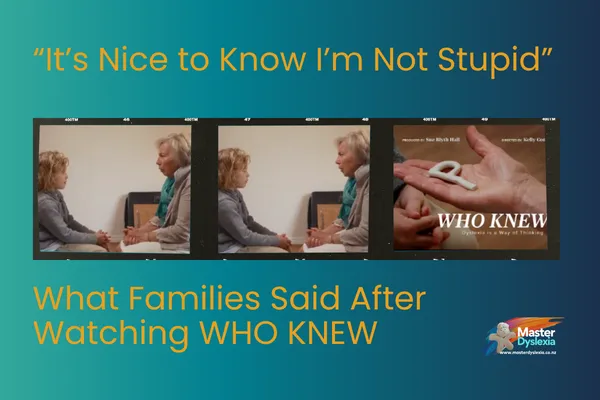
Last week, 155 people from New Zealand, Australia, Ireland, Norway, Africa and beyond joined us online to watch WHO KNEW: Dyslexia is a Way of Thinking.
When the film ended, I asked everyone to type one word into the chat.
“Gift.”
“Clarity.”
“Hopeful.”
Gill wrote:
“Never thought of dyslexia being a gift, thanks.”
Brenda wrote:
“Makes me more happy just to be me exactly as I am and not judging myself to be less than.”
And then the questions started.
Not polite questions. Not academic questions.
Real questions.
Questions that carried years of confusion, frustration, exhaustion and self-doubt.
One parent asked:
“How do I tell my child they have dyslexia?”
Another wanted to know whether their 23-year-old son could still be helped after struggling all through school.
A learning support coordinator said she would now be passing this information on to every family she works with.
Someone in Ireland stayed online until the very last moment before leaving for work because, in her words, she finally felt understood.
People were not ready to leave.
We stayed online until 9pm.
Because when people finally understand dyslexia properly, something shifts.
Not because they have been “fixed.”
Because for the first time, they stop seeing themselves - or their child - as broken.
The Real Damage Dyslexia Causes Is Often Invisible
Most dyslexic children are not struggling because they are lazy.
They are struggling because they are trying to function inside systems that do not match how their brains naturally work.
Many become experts at masking.
They copy what other students are doing.
They memorise instead of understanding.
They avoid situations that expose them.
They stay quiet because they are terrified of getting it wrong.
Some become disruptive.
Some withdraw completely.
Some decide very early they are “dumb.”
And the heartbreaking part?
Many of these children are exceptionally bright.
Creative.
Insightful.
Big-picture thinkers.
Problem-solvers.
But if they cannot spell the words fast enough, organise thoughts sequentially enough, or process language the way school expects, people assume they are less capable than they really are.
One young girl I recently worked with described it perfectly.
She said:
“I can see a beautiful red dragon in my mind with sparkles all over its wings… but all I can write is: ‘The dragon is red.’”
That is the reality for so many dyslexic learners.
The ideas are there.
The imagination is there.
The intelligence is there.
But the translation process between thought and written language becomes a bottleneck.
Teachers may see “limited expression.”
What is actually happening is cognitive overload.
When a Child Reaches Breaking Point
A mother phoned me recently. She told me what her teen boy had said to her.
"I just wish I could quit school and go and join the army."
He's coming into NCEA. He can't read. He can't write. And he's desperate to get away from that pain.
When you hear something like that, you know they mean it. And it stops your heart.
Because you know how desperate a young person must feel to say it.
This is not a child who has given up. This is a child who has been trying — for years — with the wrong tools. And he has finally run out of road.
This is what happens when dyslexia goes unaddressed for too long. Not laziness. Not attitude. A clever, creative young person who has been working harder than anyone in the room — and still falling further behind.
“There’s Nothing We Can Do”
One of the most upsetting conversations I hear from families goes something like this:
“We’ve been told: Your child has dyslexia, but there’s nothing we can really do.”
I want families to know this is simply not true.
There are tools.
There are strategies.
There are ways to work with the dyslexic mind instead of against it.
And when dyslexic learners finally experience success in a way that fits how they naturally think, the emotional change can be enormous.
Confidence returns.
Anxiety reduces.
Communication improves.
Learning stops feeling like punishment.
That is why the response to the film was so emotional.
Not because families suddenly discovered dyslexia exists.
Because they finally saw a different possibility.
Dyslexia Is Not a Measure of Intelligence
One of the comments from the evening has stayed with me ever since.
Someone wrote:
“It’s nice to know I’m not stupid.”
Imagine carrying that belief about yourself for years.
Or watching your child slowly begin to believe it.
This is why awareness matters.
Not performative awareness.
Not awareness that stops at labels.
Real understanding.
The kind that changes how we teach.
How we communicate.
How we support.
How we interpret behaviour.
How we measure intelligence.
Because dyslexic people do not need more shame.
They need environments, strategies and teaching approaches that recognise how they actually think.
Where Families Go From Here
For many families, the hardest part is not identifying dyslexia.
It is knowing what to do next.
That is exactly why Claire Ashmore and I facilitate the Davis Parent Power – Dyslexia course.
It is designed to give parents practical, usable tools that can immediately reduce stress and improve communication and learning at home.
Not years from now.
From the very first session.
Because families deserve more than:
“Wait and see.”
“Try harder.”
“There’s nothing we can do.”
There is something we can do.
And for many families, that changes everything.
If you're ready to take the next step:
The Davis Parent Power – Dyslexia course is six live Sunday sessions starting 24 May, taught online by Claire Ashmore and me. Practical tools you can use with your child or learner from the very first session.
Early Bird rate closes Monday 18 May. The first 20 registrations receive a complimentary one-hour dyslexia solutions consultation — valued at NZ$150.
👉 Register here: dyslexiasupportcourse.com/dppdmay2026booking
Questions? I'm genuinely happy to talk it through. [email protected]
Rachel Barwell is a Davis Dyslexia Facilitator and founder of Master Dyslexia, based on the Kāpiti Coast, New Zealand.
