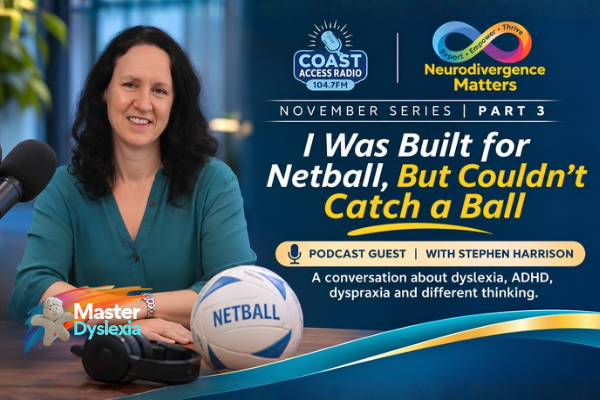
I Was Built for Netball, But Couldn't Catch a Ball
What I shared on the Neurodivergence Matters podcast about dyslexia, ADHD and dyspraxia
I'm 5'10", built for netball and basketball. Until I was about 50, I couldn't catch anything.
People were puzzled at school. I looked like an athlete, but couldn't track, catch or throw a ball. Known as "Un-co" or "Butterfingers Barwell", I often found myself as the D-Reserve on the netball team. I spent much of my adult life having accidents, bumping into furniture, dropping a lot of crockery and wondering why.
I shared that story this week on Neurodivergence Matters, a podcast hosted by Stephen Harrison of Thrival Coaching, broadcast on Coast Access Radio and available on Spotify and Apple Podcasts. The podcast is made for anyone who knows that brains don't all work the same, and that this is a strength, not a flaw. That's exactly how I see it too. Stephen and I share a very similar approach to neurodiversity, and his questions drew out some things I don't often say out loud. Here are a few of them.
Finding my own answers
My path to this work started more than 20 years ago, with a book that jumped off the shelf: Ron Davis's 'The Gift of Dyslexia'. I bought it to understand someone I loved.
Years later, working in adult literacy education, I met a colleague who worked with the Davis Method. I asked her what made it different from other dyslexia methods. She said, "It really works, and it really lasts." Both of those mattered to me, so I trained as a Davis Facilitator myself, and along the way I found some life-altering answers about myself.
During that training I discovered my own ADHD and dyspraxia, the clumsy neurodiversity. The relief was enormous. My clumsiness wasn't something fundamentally wrong with me. It had a real cause, and there were tools that could really help.
Today I have far fewer accidents and much more social poise and confidence. I can play sport and enjoy it, and I love shooting hoops, which simply wasn't possible before.
That's why I particularly enjoy working with young people who have some form of dyspraxia. So much of life in Aotearoa is centred around sport, and not participating can be isolating. Around the age of 12, I took up piano and swimming, which unknowingly helped my brain, and I experienced some level of success. But they were solo pursuits, and I missed out on valuable lessons of teamwork and camaraderie. When a client of mine learns to ride a bike or play football and joins in with their friends, it matters just as much as, if not more than, passing a spelling test.
The boy who made the alphabet stand still
Stephen asked me about Ron Davis, who’s passing earlier this year first connected the two of us.
Ron was a non-speaking autistic and dyslexic child, judged unable to be educated. He began to emerge from the void of autism when he modelled the letters of the alphabet in red clay, and the alphabet strip around his classroom wall finally stopped moving. Decades later, as a sculptor, he noticed he was "at his dyslexic worst when he was at his artistic best." That clue led him to discover perceptual disorientation, and to create the Davis Methods I use today.
When time makes no sense
One story from my practice drew a strong response from Stephen.
A very bright 14-year-old client was always anxious about time yet had no real sense of it. She constantly asked her family how long things would take, and when they would end. Together we worked on the concept of time in a hands-on way. She estimated how long it would take to make a cup of tea, then made it and timed it. Then I gave her some homework: "Before your journey home, estimate how long it will take, then time it and tell me tomorrow."
Something shifted for her. She had a real, physical anchor for something that had always felt uncertain, and her family said her time-anxiety disappeared.
The same difficulties with estimating the passage of time often show up as the "Sunday-night assignment panic" many families know well. Without a solid sense of time, planning is very hard, and everything piles up at the last minute. I know that pattern from the inside. Before I understood my ADHD, I was famous for pulling all-nighters to meet deadlines, as a student and in my early working life. You can do it, but it's unsustainable. Over time, regular all-nighters exhaust our brains and bodies deeply.
From wanting to quit, to a career in law
I closed the interview with a story I love. Last year I worked with a 5th-year law student who was about to give up on law. She was getting Cs in her academic papers and As in her practicals, and dyslexia was holding her back.
After we worked together, she achieved As and Bs in her final semester. She went on to pass her bar exams, and she's now working as a young lawyer in her hometown.
These are stories from my own life and practice, and every person is different. But they show what can open up when a neurodivergent person finally understands how their own mind works, and how to maximise its talents.
They won't grow out of it
Stephen asked what message I'd like to leave with families. This is what I said:
"Don't wait and hope that the young person will grow out of the challenge. They won't. They're neurodiverse, they have those brains for life. But it's how we learn to use them in the most powerful way and thrive in our lives.
"The sooner a difference is understood, the more options a young person has to enjoy learning and feel good about themselves, rather than believing they're dumb, or not academic. It's quite the opposite."
If you listen to just one part of the interview, start at about 22 minutes, where I talk about technology, gaming and navigating real-world consequences for people with ADHD.
My thanks to Stephen for a generous and thoughtful conversation. You can listen to the full episode, with a transcript and show notes, on Stephen's Thrival Coaching website, or search for Neurodivergence Matters on Spotify or Apple Podcasts.
Next week
Next week I'll explore the technology, gaming and neurodiversity conversation in more depth.
Talk it through
If something in these stories sounds familiar, a short conversation is the easiest place to start. We can talk about what you're noticing, and whether Davis Mastery for Dyslexia, Davis Mastery for Attention or another Davis programme might suit your child, or you.
Ngā mihi nui,
Rachel
