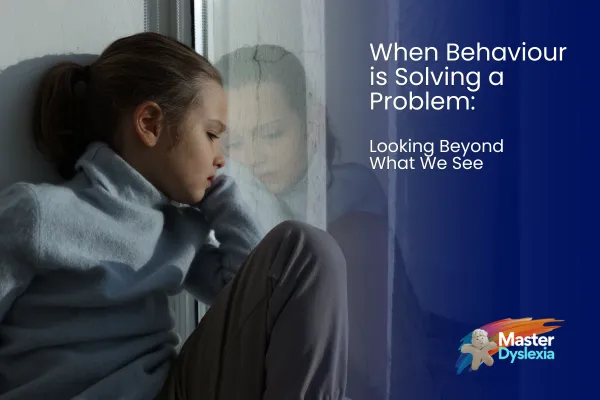
When Behaviour Is Solving a Problem: Looking Beyond What We See
Every Behaviour Has A Purpose
As parents, teachers and grandparents, we naturally notice behaviour.
The child who refuses to write. The one who talks non-stop or seems permanently distracted. The one who melts down over what appears to be something small, or who constantly leans on others to get through a task.
When these patterns repeat, it's easy to reach for a simple explanation. "They're just lazy." "She's always looking for attention." Over the years, I've learned that those conclusions are often wrong.
More often than not, the behaviour isn't the real problem.
It's a creative solution to some kind of threat.
Our brains are incredibly resourceful. When something feels difficult, overwhelming or confusing, we naturally look for ways to make it easier. Children do this instinctively. Adults do it too.
A child who struggles to organise their thoughts may ask someone else to answer for them. A student who finds writing exhausting may avoid picking up a pencil altogether. And sometimes the strategies are so subtle that even the person using them doesn't realise they're doing it — the child who becomes wonderfully charming, discovering that if someone else helps, life feels much easier. The teenager who becomes the class clown, changing the focus before anyone notices they're struggling.
These aren't signs of failure. They're signs that the brain has found a way to cope.
I see this particularly clearly with dyslexic learners. And I see the toll it takes on the parents watching it happen — the confusion of knowing your child is capable, and yet watching them shut down, deflect or push back in ways that make no obvious sense. That gap between what you know about your child and what you're seeing in front of you is exhausting. And it deserves a better explanation than "difficult."
A Better Question to Ask
One of the biggest shifts I see in families happens when they stop asking "how do we stop this behaviour?" and start asking "what problem is this behaviour trying to solve?"
That question changes everything.
Instead of becoming frustrated, we become curious. Instead of correcting the behaviour first, we begin to understand what sits underneath it. Because behaviour rarely appears without a reason. There is almost always something driving it.
Looking Beneath the Surface
From the outside, we only see the behaviour. We don't always see the effort it takes simply to get through the day.
A child who always asks for help may actually be avoiding the uncomfortable feeling of making a mistake. A child who appears stubborn may simply be overwhelmed by too many instructions at once. Someone who avoids reading aloud may be protecting themselves from embarrassment they've experienced too many times before.
When we only respond to the behaviour, we can unintentionally miss the message.
Confidence Changes Behaviour
One of the most rewarding parts of my work is watching these behaviours begin to fade.
Not because someone has been punished. Not because they've been told to try harder. But because the original difficulty has started to disappear.
As confidence grows, the need for the coping strategy becomes smaller. Children begin answering for themselves. Adults begin trusting their own thinking. The behaviour changes because the underlying problem has changed.
That is very different from trying to force someone to behave differently.
Dyslexia Is About More Than Reading
This is why, when families come to me, we rarely focus on reading alone.
People often come expecting to work on reading, spelling or writing. Of course those things matter. But dyslexia doesn't exist in isolation. It influences confidence, decision-making, energy and the way people see themselves.
When we support the whole person rather than just the literacy, we often see changes that reach far beyond the page. Families frequently tell me: “They are more focussed”. "They're becoming more independent." "They're happier." "They're willing to have a go now."
Those changes don't happen because someone suddenly became a different person. They happen because they no longer need the behaviours that once helped them survive.
Before We Judge...
The next time you notice a child avoiding a task, becoming frustrated or relying heavily on someone else, pause before assuming you know why.
Instead of asking "what's wrong with this behaviour?" try asking "what problem might this behaviour be trying to solve?"
That single question creates space for understanding. And understanding is often the first step towards lasting change.
Because behaviour is rarely the whole story. Sometimes it's simply a clever brain doing its very best to navigate a world that feels much harder than it appears.
When we look beyond the behaviour, we begin to see the person.
And that's where real transformation begins.
If this resonates — whether you're a parent trying to make sense of what you're seeing, or someone who recognises their own story here — I'd love to hear from you.
Email me directly: [email protected]
