Why Dyslexia Education Is a Global Issue — Not Just a Classroom One
A Different Kind of Global Challenge
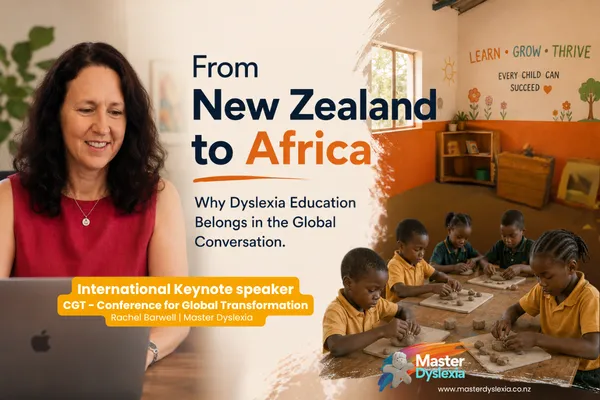
This month, I had the privilege of being invited as a closing keynote speaker at the Conference for Global Transformation.
It was an extraordinary space to be a part of. The conference brings together people working on large-scale change across the world — from education and health projects to clean water access, community development and human rights.
My contribution was to speak about dyslexia education, the work we do here in New Zealand, and the growing impact of dyslexia support in parts of Africa.
At first glance, dyslexia education may not seem like a global transformation issue.
But it is.
When a child cannot access learning in the way their brain is naturally wired to learn, the impact does not stay in the classroom. It affects confidence. It affects opportunity. It affects families, communities and the paths their lives can take.
Africa is home to the youngest population on earth, with a vast generation of young people carrying enormous potential. Within that potential is a challenge that is often hidden: many dyslexic learners are still misunderstood, stigmatised, unsupported or left behind.
How Dyslexia Actually Works
Dyslexia is not a lack of intelligence. It is not laziness. It is not a child "not trying hard enough."
It is a different way of processing information.
For many dyslexic learners, traditional literacy instruction does not match how their brain naturally works. They may think in 3-D pictures, patterns, movement, feelings and meaning — rather than in straight lines of 2-D text. When teaching relies heavily on memorisation, worksheets and repetition, these children can quickly become exhausted, anxious or convinced they are failing.
The tragedy is they end up thinking they cannot learn. But they can.
The real tragedy is they are never shown how to learn the way they learn.
What's Happening in Kenya and Nigeria
In places like Kenya and Nigeria, teachers and grassroots educators are beginning to change that story. With limited resources but deep commitment, they are bringing practical, visual and hands-on dyslexia support into classrooms and communities.
In Kakamega County, Western Kenya, a new preschool and kindergarten opened in February 2026 to support very young neurodivergent learners. The focus is simple but powerful: hands-on, visual methods that help children connect with letters, words and learning in a way that makes sense to them.
I am personally involved in supporting this project — and if it speaks to you too, you can contribute directly here: https://thekakamegaproject.raiselysite.com/
Every contribution helps put the right tools into the hands of the people closest to these children.
In Delta State, Nigeria, local advocates are adapting dyslexia literacy tools for their own communities, training teachers, and now running a school for neurodivergent pupils. This is how real change begins — not as a theory, but as a network of people who understand that different learners need different pathways.
Beyond Awareness: The Next Step Is Action
What inspires me most is that this work is moving beyond awareness.
Awareness matters, but awareness alone does not teach a child to read. It does not give a teacher practical tools. It does not restore confidence to a child who has spent years being told — directly or indirectly — that they are the problem.
The next step is action and intervention.
The next step is equipping parents, teachers and communities with approaches that recognise how dyslexic learners actually think.
That is true in Africa. And it is true here in New Zealand.
What Changes When the Approach Finally Fits
Every week, I meet bright children, capable teenagers and intelligent adults who have carried the weight of being misunderstood. Some have been told they are stupid. Careless. Some have been told they need to try harder. Some have developed remarkable coping strategies just to survive school, work or study.
And yet, when they finally receive support that fits the way their brain naturally works, something profound changes.
They begin to see themselves differently.
They begin to understand that their struggles were not a reflection of their ability. They were a sign that the teaching approach had not matched them as a learner.
That is why this conversation belongs on a global stage.
Because dyslexia education is not only about reading and spelling. It is about access. It is about dignity. It is about making sure intelligent, creative, capable people are not locked out of opportunity because their brain does not process written language in the expected way.
When we support dyslexic learners well, we do not simply improve literacy outcomes.
We change the trajectory of their lives.
We help children stay connected to learning. We help adults reclaim confidence. We help families understand what is really going on. We help teachers see the learner behind the struggle.
And in communities where resources are stretched, the right knowledge can be transformational.
The Message From New Zealand to Africa
The work happening in Kenya and Nigeria is a powerful reminder that change does not always begin with perfect systems or unlimited funding. Sometimes it begins with one trained teacher, one supported child, one classroom willing to do things differently.
From New Zealand to Africa, the message is the same:
Every child deserves the opportunity to learn in a way that works for their brain.
When we empower dyslexic minds, we do more than change individual lives.
We unlock potential that has been waiting to be seen.
If something in this article landed for you — whether you're a parent wondering about your child, a teacher looking for better tools, or an adult who recognises their own story here — I'd love to hear from you.
Email me directly: [email protected]
