The Costume We Don’t Know We’re Wearing
There is a joke that circulates among adults diagnosed with dyslexia later in life.
“I wasn’t struggling,” they say. “I was just very creative.”
It gets a laugh. It also tells you something true.
Because that creativity was often real — resourceful, inventive, and impressive. But it was also exhausting. And for a very long time, nobody had a name for what it actually was.
Masking.
It is one of the most common, least talked-about experiences in the dyslexic and neurodivergent world. And it may be happening in your family right now, without anyone realising it.
What is masking in dyslexia and ADHD?
Psychologists call it camouflaging: the ways neurodivergent people adapt their behaviour to fit social, educational, or workplace expectations. It can mean hiding difficulties, compensating for them so effectively that others don’t notice, or working around them so consistently that the workarounds become invisible — indistinguishable from personality.
In dyslexia, masking may look like:
• Memorising rather than reading
• Choosing simpler words to avoid spelling errors
• Spending two or three times longer on a task than peers — in private, never letting anyone see the effort
• Talking around a topic confidently rather than ever writing anything down
In ADHD, masking may look like:
• Over-preparing for every situation
• Running on anxiety as a substitute for executive function
• Being a great talker.
• Taking on too many things, then running around in a frenzy to get then all done, to your own detriment.
• People-pleasing, or using humour to deflect
• Looking calm and organised on the outside while internally tracking every possible thing that could go wrong
From the outside, it can look like competence. From the inside, it can feel like performing a character you’ve spent decades perfecting, in a show that never gets to close.
Research consistently links long-term masking with exhaustion, chronic stress, burnout, and delayed diagnosis. The struggle doesn’t disappear — it goes underground.
It looks different depending on where you grow up
I’ve been working with an international group of educators for the past four years, and what has struck me most is how much the shape of masking is formed by the world around it — by what that world demands, and what it punishes.
In Kenya, an educator describes children who sit at the back of the class so they can’t be called on. Who hide their homework because they haven’t been able to do it well enough, knowing punishment is coming. Who leave home in the morning and hide in the bush until evening rather than face another day in a classroom that reads their difficulty as defiance. Some have dropped out of school altogether.
These children are not disengaged. They are exhausted by a system that has no language for what they’re experiencing — and so labels them slow, lazy, or stupid.
In Nigeria, a teacher and mother describes a different picture. Her five-year-old son Richmond can answer questions aimed at Grade 3 children. His verbal reasoning is extraordinary. But when it comes to reading or putting pencil to paper, a different child appears. He navigates this by asking his older brother to read instructions aloud — and then contributes his own insights and ideas. His gift has become, partly, his cover.
Another child, ten-year-old Bright, excels in mathematics, crafts, and practical activities. Teaches his classmates with confidence. But will not step into any spotlight that involves reading aloud or public performance. In many classrooms, this reads as shyness. It may actually be the hidden effort of a child protecting himself from exposure.
Neither of these children is failing. They are solving a problem — the only way they currently know how.
In Aotearoa, the picture is different again. Many bright dyslexic learners become what you might call “successful failures” — children whose results look acceptable on paper, but whose achievement is built on invisible hours of effort, parental scaffolding, and deep exhaustion. The system is satisfied. The child is not.
For Māori and Pasifika learners navigating both a neurodivergent experience and an institution that may not reflect their culture, language or value their ways of knowing, this exhaustion is compounded. They may be masking across multiple dimensions at once — neurodivergent, cultural, linguistic — and the toll is not simply additive. It builds.
It runs in families
Here in Aotearoa, one of the things I’ve come to understand is that masking rarely stays with one person. It ripples through the whole whānau.
The parent who always reads the school newsletter aloud at dinner “because it’s easier.” The older sibling who quietly checks homework without being asked. The mum who phones the school rather than emails because writing has always felt risky. Nobody planned this. It just became the way the family works.
And sometimes — without anyone intending it — that well-meaning support deepens the mask. The unspoken message the child absorbs isn’t “we’re here for you.” It’s: this is something we work around, not something we talk about.
Learning happens in relationship. The cost of masking is often felt across the whole whānau, not just by the individual. And when real understanding arrives — not just a label, but a genuine shift in how someone is seen — it can change things for the whole family.
What changes when confusion is understood
Ron Davis, whose work underpins the Davis Method, made an observation I return to often. He noticed that highly intelligent people develop ingenious solutions to confusion. Those solutions can become so successful that nobody sees the original challenge anymore — sometimes not even the person themselves.
The question he asked wasn’t “how well is this person coping?” It was: what confusion is this person trying to solve?
That shift matters more than it might seem. Because a confusion that can be named can be understood. And a confusion that can be resolved doesn’t need to be masked anymore.
When confusion reduces, the need for compensation reduces too. The energy that went into managing, hiding, performing, checking, and recovering becomes available for something else. For learning. For creativity. For discovering what a person is genuinely capable of, once they’re no longer spending everything they have on staying hidden.
A conversation I’d love you to be part of
Next Saturday evening — 8pm NZT, Saturday 27 June — a full international day of talks begins as part of the Davis UK & Ireland Neurodiversity Day: “Dyslexia: Behind the Mask”, running through to 7am Sunday 28 June NZT.
At 8.30pm NZT, my colleague Claire Ashmore and I are hosting our panel discussion: “What Neurodivergent Survival Looks Like Across Cultures.”
We’ll be joined by Geoffrey Ashiono, a dyslexia educator and founder of a specialist kindergarten for neurodivergent pupils from Kenya, and Francisca Adagbon, a specialist neurodivergent school founder from Nigeria. Together we’ll be exploring what neurodivergent survival actually looks like across cultures — the adaptations, the coping strategies, the masks people develop when the world around them doesn’t understand how they think and learn.
We warmly invite you to join us, as we all share from both our personal experiences and professional observations of masking in dyslexia.
Live attendance is free.
Recordings are available for £12.99 if you can’t join live.
Register here → davismethod.co.uk/event-details/dyslexia-behind-the-mask
If any of this has felt familiar — if you recognised yourself, your child, or someone you support in what you’ve read — I’d love to hear from you.
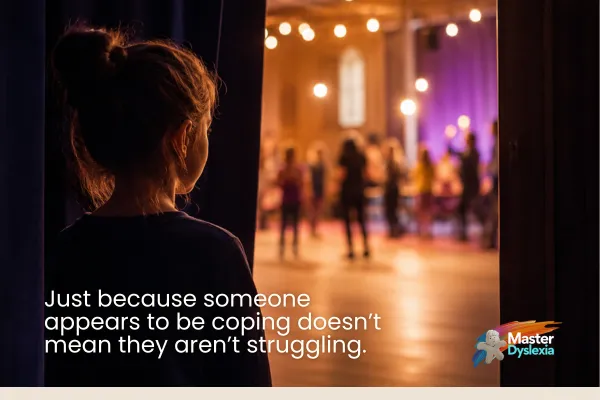
The most important thing masking teaches us is this: just because someone appears to be coping doesn’t mean they aren’t struggling. And just because the struggle is invisible doesn’t mean it isn’t real.
Rachel Barwell is a specialist Davis Dyslexia Facilitator based on the Kāpiti Coast, Aotearoa New Zealand, and founder of Master Dyslexia. She works with dyslexic and neurodivergent individuals of all ages, and is personally committed to expanding dyslexia education and awareness across Aotearoa, New Zealand and Africa.
Interested in understanding more about how the Davis Method could help? Book a free discovery call.
