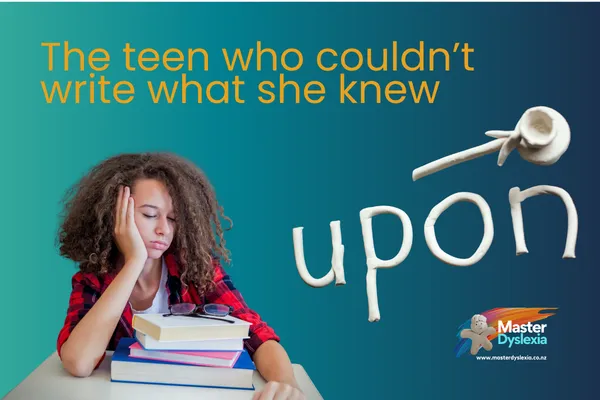
The Teen Who Couldn’t Write What She Knew | Master Dyslexia
What dyslexia actually looks like in bright, hardworking people — and what changes when learning finally fits the brain.
She sat across from me and described what she wanted to say. Vivid. Detailed. Completely alive in her head.
Then she picked up the pen.
Nothing came out.
Not because she didn’t know what she wanted to write. Because the gap between what she could think and what she could produce on paper had become so wide that she’d stopped trying to bridge it.
This is a teenager who can hold complex ideas, read a room, solve problems that stump her peers. At school, she’s considered behind.
The school isn’t wrong, exactly. She is behind — on the metrics the school measures. But those metrics measure how well a picture-thinking brain can perform word-thinking tasks. And that’s a bit like measuring a fish by how well it climbs a tree.
The pattern I see
Here’s what I’ve noticed over years of working with dyslexic learners: the gap isn’t between what they know and what they don’t. It’s between what they know and what they can show.
They think in full colour. They communicate in fragments — because the bridge between their rich internal world and the written page is broken.
And the longer this goes on, the more the child concludes that the problem is them.
I have sat with adults in their forties, fifties, seventies who still carry that conclusion. Felicia Nagamatsu came to the Davis Parent Power – Dyslexia course at 72. She described what her life was like before:
“Before learning Davis Methods, I hated myself. I was tired of life.”
And after:
“The internal war is over. I am loving life.”
Seventy-two years old. The internal war finally over. That is what is at stake when we leave dyslexia unaddressed.
What the Davis tools actually do
There are two distinct sets of tools at the heart of the work.
The first is what we call mental orientation — giving a picture-thinking brain a stable anchor point so it can settle, focus, and engage with two-dimensional text and symbols without the spinning, drifting, or shutdown that comes when disorientation kicks in. This isn’t a concentration trick. It’s addressing what’s actually happening neurologically when a dyslexic learner hits a wall.
The second is clay modelling for word mastery. Picture-thinkers struggle with words that have no naturally occurring picture connected to them — words like was, the, between, because. These are the words that appear on every page of every book, yet they register as a blank or confusion for a picture-thinking learner. When a learner builds a word-model in clay — creating a physical, three-dimensional representation of its meaning — it enters memory differently. It sticks. Not because we forced it in through repetition, but because we gave the brain what it was asking for: something real to hold onto.
Sarah brought her son Lachie to the course after years of programmes that produced little change:
“We knew this was going to be different. From the very first session, we knew.”
The teenager across the table
She’s doing better now. Slowly, the gap between what she knows and what she can show is closing. Not because she’s trying harder. Because she finally has the right tools.
The parents and educators who go through the Davis Parent Power – Dyslexia course learn to use these tools themselves — at home, in the classroom, in the moments that matter. Six live sessions. Practical from the first week.
Desiree, a tertiary educator who attended, put it simply:
“The tools are pretty amazing. They are my go-to when my family has a hiccup. You can see they work.”
Two ways to take the next step
🎥 Last free NZ screening of WHO KNEW: Dyslexia is a Way of Thinking — Tuesday 12 May, 7pm NZT. 33 minutes that reframes everything. No replay available. Last NZ screening for a while.
Register free: masterdyslexia.co.nz/who-knew-dyslexia-solutions
⏰ Davis Parent Power – Dyslexia course — Early Bird closes Thursday 15 May.
Six live Sunday sessions, starting 24 May. Co-facilitated by Claire Ashmore and me. Everything you need to support your child’s learning the way their brain actually works.
Bonus: The first people to register and pay between Tuesday 12 May and Thursday 15 May receive a complimentary one-hour dyslexia solutions consultation with Claire or me — valued at NZ$150.
Full details: dyslexiasupportcourse.com/dppdmay2026
Rachel Barwell is a Davis Dyslexia Facilitator and founder of Master Dyslexia, based on the Kāpiti Coast, New Zealand. She works with dyslexic learners, their families, and the educators who support them.
