When a Dyslexic Child Can See Everything But Can't Spell the Words
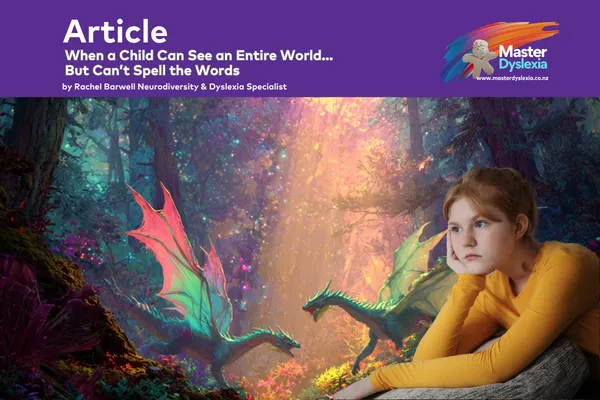
I sat with a young girl this week who read to me from a graphic novel about dragons. Not perfectly. Not fluently in the way schools tend to measure. But what was happening in that room was something else entirely. She didn't just read the story. She understood it. When she finished, she began describing the world inside the book: the characters, their powers, the relationships between them. It was as if she were narrating a film playing in her mind. Her grandfather just looked at me. Because what came out of her was not struggle. It was brilliance.
What Most People See vs What's Actually There
If you looked only at her writing, you might see inconsistent spelling and missing punctuation. And you might conclude: "She's behind." But that's not what I saw. I saw complex narrative thinking and deep comprehension. A vivid internal world most adults would struggle to articulate.
This is the gap we keep missing. Not a gap in intelligence. A gap in translation.
The Translation Problem in Dyslexia
For many dyslexic learners, thinking doesn't happen in words. It happens in images. In movement. In fully formed, multi-dimensional concepts. But school, and much of life, demands something very different: linear expression and fast verbal recall.
So what happens? A child who can see everything… struggles to show anything.
What Changed
Fifteen months ago, this same girl was fascinated by these worlds, but couldn't access them easily through reading. Now she has modelled over 100 words. She reads graphic novels with high accuracy. She is beginning to move toward chapter books. And most importantly, she wants to.
Her grandmother said to me: "I'm so grateful. She can finally access the worlds she's always been drawn to." That's the shift. Not just improvement. Access.
If this resonates, join us for a free webinar where we screen the WHO KNEW film and introduce practical tools you can start using with your child straight away.
Thursday 30 April, 7pm NZT / 5pm AEST
Tuesday 12 May, 7pm NZT / 5pm AEST
Free and online — but no replay.
Register here: masterdyslexia.co.nz/who-knew-dyslexia-solutions
The Behaviour We Misread
There were still moments of resistance. Frustration. Pushback. What many would label as "defiance." But when you understand what's underneath, it looks very different. It's not defiance. It's a human response to not being understood and not being able to express what feels obvious internally.
When we change how we see that behaviour, everything changes.
What If We're Measuring the Wrong Thing?
This isn't a rare case. I see this pattern again and again. Children—and adults—who are highly intelligent and deeply creative, being measured by their ability to produce correct spelling and structured writing under pressure.
Those are useful skills. But they are not the same as intelligence.
The Real Work
The goal isn't to "fix" the child. It's to build the bridge. To help them translate what they already know and express what they can already see. Because once that bridge is in place… Everything opens.
If you're seeing this in your child, or in yourself, you're not imagining it. There is often far more going on beneath the surface than the system recognises.
If you'd like to understand more about how this works — and what it could mean for your child — join us for a free webinar where we screen the WHO KNEW film and walk through practical tools you can start using straight away.
Thursday 30 April, 7pm NZT / 5pm AEST
Tuesday 12 May, 7pm NZT / 5pm AEST
Co-hosted by Claire Ashmore and me. Free and online — but no replay.
Register here: masterdyslexia.co.nz/who-knew-dyslexia-solutions
Or if you'd prefer to talk through your child's specific situation first, I offer discovery calls — reach out directly and we'll find a time.
