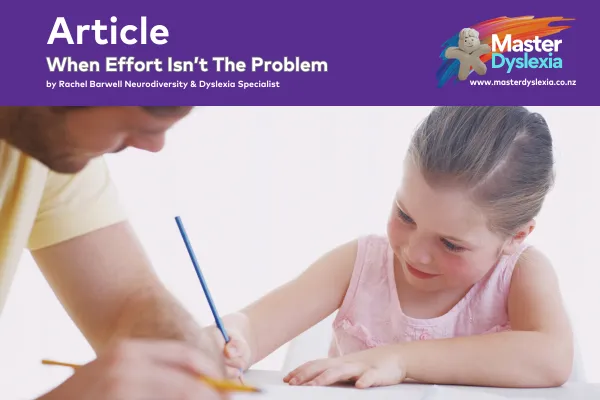
When Effort Isn't The Problem
When Effort Isn’t the Problem
Parents often come to me feeling confused.
They’ve increased support.
They’ve adjusted routines.
They’ve encouraged effort.
And still, learning feels fragile.
Their child wants to do well. They try hard. Sometimes they even push themselves beyond what feels comfortable.
Yet their results don’t reflect the effort being made.
This is usually the point where families start asking harder questions.
“They’re Trying - So Why Is It Still So Hard?”
Many children are putting in more effort than we realise.
They are concentrating intensely just to keep up.
They are managing frustration quietly.
They are holding information in mind while their body wants to move.
From the outside, it can look like inconsistency.
From the inside, it often feels like overload.
When learning demands exceed a child’s capacity to regulate, effort alone can’t bridge the gap.
Cognitive Load Is Invisible - But Powerful
Every learning task carries load.
Listening.
Processing language.
Remembering instructions.
Managing emotions.
Staying seated.
Producing work on demand.
For some learners, these demands stack quickly.
A task that looks simple on paper may require multiple systems working at once. When those systems are stretched, learning becomes unreliable.
Not because the child doesn’t care.
Not because they aren’t capable.
But because their brain is working hard just to stay engaged.
Why More Pressure Often Backfires
When progress stalls, adults naturally respond by increasing support or expectations.
More reminders.
More practice.
More encouragement.
But pressure adds load.
And when load increases, regulation often decreases.
This is when parents notice emotional reactions, withdrawal, shutdown, or exhaustion — sometimes long before academic difficulties show up.
The learning problem isn’t always the learning.
It’s the conditions around it.
Regulation Changes Access
A regulated nervous system allows a child to:
access memory
tolerate challenge
integrate new information
recover from mistakes
.
Without regulation, learning becomes effortful and short-lived
This is why the same child can appear capable in one setting and overwhelmed in another.
Environment matters.
Timing matters.
How learning is presented matters.
When Learning Starts to Feel Safer
Families often describe a shift when learning begins to align with their child’s needs and thinking style.
Things don’t suddenly become easy.
But they become steadier.
There’s less resistance.
Less emotional fallout.
More willingness to engage.
Confidence grows not from pushing harder, but from feeling safer while learning.
Moving Forward With Clarity
The goal isn’t to demand more effort.
It’s to reduce unnecessary load.
When learning approaches respect how a child processes, regulates, and recovers, progress becomes more sustainable.
Not perfect.
Not linear.
But calmer.
And more hopeful.
And for families who have already done the work of understanding, that alignment can make all the difference.
Want to explore what learning alignment can look like?
Book a free call with me on https://bit.ly/DyslexiaExplore
