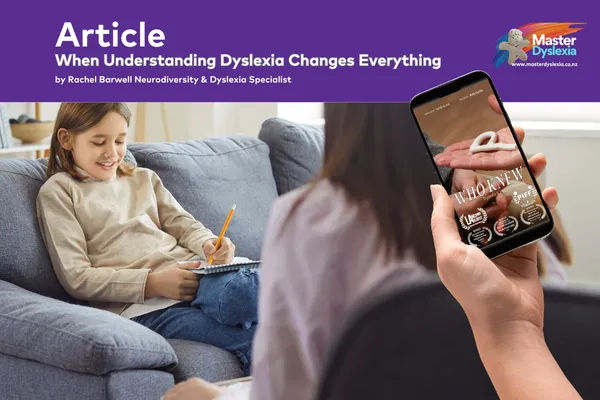
When Understanding Dyslexia Changes Everything: Support for Dyslexic Children in NZ
For years, I watched families hit the same wall.
Not because they weren't trying hard enough. Not because their child wasn't capable.
But because they were working from an incomplete understanding of what dyslexia actually is.
I know this intimately. I'm neurodivergent. I think in pictures a lot — though not exclusively — and I've navigated a world that doesn't always make space for brains like mine. Now, as a Davis Dyslexia Facilitator working with families across New Zealand, I sit with parents who are exhausted, confused, and watching their bright child call themselves "stupid" — and I see the exact moment when the light goes on.
That moment changes everything.
The Common Misunderstanding About Dyslexia
Most people still think dyslexia is a reading problem. A deficit to fix. A gap to close.
And yes, reading challenges are real. But they're only part of the picture.
What goes unseen is how a dyslexic child is actually thinking.
Because for many of them, dyslexia isn't a deficit at all. It's a completely different operating system — one that processes the world through pictures, movement, and experiences rather than words alone.
Dyslexia Is a Way of Thinking
Some people think primarily in words and sound. Others — like the kids I work with — think in images.
They don't just hear information. They see it. They build meaning in ways that don't always show up neatly in a traditional classroom.
This is what we call picture thinking dyslexia — a brain that naturally visualises concepts, solves problems spatially, and creates meaning through mental imagery.
In a world that runs on language, this difference is easy to miss. But it matters. Deeply.
And when parents understand this distinction, they can finally start to support their dyslexic child at home in ways that actually work.
When a Single Moment Changes Perspective
Just last week, we ran free screenings of the WHO KNEW: Dyslexia Is a Way of Thinking film across New Zealand and Australia.
Nearly 400 people registered. Over 200 joined us on Zoom.
But what stayed with me wasn't the numbers. It was the moments of recognition.
One mum told me afterwards that a single visual in the film helped her finally understand how her daughter experiences the world. For the first time, she could see it.
Not as confusion. Not as resistance. But as a different way of thinking.
That moment — when something clicks — changes the entire trajectory of how to help a dyslexic child moving forward.
When Effort Goes Unseen
So many dyslexic kids are working harder than anyone realises.
They try to keep up. They practise. They push themselves.
And when the results don't reflect that effort, a quiet narrative begins:
"I'm not good at this."
"I must be behind."
"Maybe I'm just not smart."
Over time, this stops being about learning. It becomes about identity.
And that's the part that breaks my heart — because it's not true.
How the Davis Method Supports Dyslexic Children
When we start to see dyslexia differently, the whole conversation shifts.
The focus moves away from "What's wrong?" and towards "How is this child thinking?"
That shift opens the door to something far more useful than correction: understanding.
The Davis Method for dyslexia is built on this foundation. It teaches children how to work with their picture-thinking brain — not against it.
Instead of forcing a dyslexic child to think like a word-thinker, we give them tools to manage their natural orientation, use clay modelling to master tricky words, and read in a way that aligns with how their brain actually processes information.
This is dyslexia support in NZ that honours the child's strengths, not just their struggles.
What Comes Next: Practical Dyslexia Support for Parents
The film screenings opened an important conversation. But they also revealed something else:
Parents aren't just looking for awareness anymore. They're looking for a way forward.
Because once you understand what's really happening, the next question becomes:
"Okay. So what do I actually DO with this?"
That's the space I'm stepping into now — with my Davis Dyslexia colleagues, and with a community of parents who are ready to move from understanding to action.
We're running two more free webinars where we'll watch the WHO KNEW film together, and then I'll share what becomes possible when we stop trying to fix something that was never broken.
Join us:
🗓️ Thursday 30 April, 7pm NZT / 5pm AEST
🗓️ Tuesday 12 May, 7pm NZT / 5pm AEST
Same content, two dates — pick what works for you.
Register here: https://masterdyslexia.co.nz/who-knew-dyslexia-solutions
Because when understanding changes, what becomes possible changes too.
