When Your Child's Learning Progress Feels Slower Than It Should
February 2026 • 5 min read
Is your child falling behind, or are they just building a deeper foundation?
As parents, we carry a quiet timeline in our minds. "By 8, they should be reading fluently. By 10, the meltdowns should have stopped". When the reality doesn't match the timeline, the 'urgency' starts to creep in.
But after years of working with neurodivergent learners in Wellington, I've seen that 'slow' rarely means 'stuck'. . .
The Pressure of Comparison
In classrooms, progress is often measured collectively.
Children move through material together.
Milestones are shared.
Benchmarks are visible.
This structure works well for many learners.
But for others, particularly those with dyslexia or ADHD, it creates quiet pressure.
A child may begin to notice they are working harder for the same outcome. They may see classmates finish quickly while they are still processing the first step. They may begin to feel as though learning is something they must “catch up” to, rather than something they can move through safely.
Comparison doesn’t always arrive through words.
Sometimes it arrives through silence.
A glance at another child’s page.
A teacher saying “we’re nearly finished.”
A sense that time is running out.
Over time, this pressure can shape how a child approaches learning.
Not with curiosity.
But with caution.
Why Neurodivergent Progress Isn't Always Linear
Progress is often imagined as steady forward motion.
But learning is rarely linear.
Some children consolidate deeply before moving on.
Some need repetition to build security.
Some revisit the same skill in different ways before it truly settles.
From the outside, this can look like delay.
From the inside, it may simply be integration.
A child might be learning slowly because they are building a foundation that will hold. They may be developing understanding in layers. They may need time for the skill to become familiar enough to feel safe.
This isn’t always visible.
And because it isn’t visible, families often worry that progress is not happening.
But slower does not automatically mean stuck.
Sometimes slower means the brain is doing more work behind the scenes than we realise.
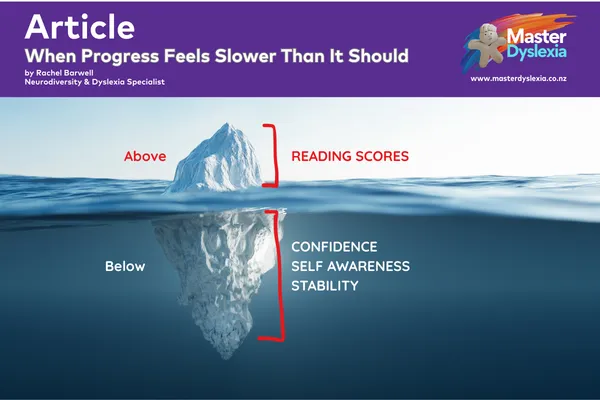
The Invisible Work Beneath the Surface
Even when visible progress feels slow, there is often unseen learning happening.
Children may be:
building understanding gradually
increasing tolerance for challenge
learning to stay engaged for longer
recovering more quickly after mistakes
strengthening attention and follow-through
developing internal strategies and self-awareness
These shifts do not always show up immediately in reading scores, spelling tests, or classroom output.
But they matter.
They are signs that learning is becoming more sustainable.
Parents often notice these shifts first.
A child who used to avoid learning begins to sit down more easily.
A child who would melt down after one mistake begins to try again.
A child who used to shut down becomes more willing to ask questions.
This is progress.
It is just a different kind.
When Urgency Adds Weight
When progress feels slow, adults understandably feel urgency.
More practice.
More support.
More reminders.
The intention is always care.
But urgency can add pressure.
And pressure can narrow access.
Children who already feel behind may become more cautious when expectations increase. They may begin to associate learning with stress, time pressure, and the feeling of never quite reaching the finish line.
Not because they don’t want to improve.
But because speed feels risky.
When learning becomes a race, safety can disappear.
And when safety disappears, learning becomes harder to access.
This is why pushing harder does not always produce better results.
Sometimes it produces fatigue.
Sometimes it produces resistance.
Sometimes it produces a child who appears capable but emotionally overwhelmed.
I remember that feeling of urgency myself—the desperate wish to just 'fix' the pace. But I’ve learned that when we force the speed, we often break the safety.
What Parents Often Misinterpret
One of the hardest things for families is not knowing what to trust.
A child may seem to improve, then plateau.
They may make gains, then slip again.
They may succeed at home, then struggle at school.
This inconsistency can be unsettling.
Parents may assume it means progress has been lost.
But often, it means the child is still building stability.
Learning support is not only about understanding.
It is also about access.
And access depends on many things: energy, emotional state, environment, pressure, fatigue, and confidence.
When these factors shift, learning shifts with them.
That doesn’t mean the child has failed.
It means their capacity has changed.
A Different Way to View Progress
Instead of asking, “Is this fast enough?”
It can sometimes be more helpful to ask, “Is this becoming steadier?”
Steadiness shows up in small ways.
Less resistance.
More willingness to try.
Fewer emotional crashes.
Longer stretches of focus.
More confidence to begin.
These changes are easy to overlook when the focus is on pace.
But they signal growth.
And growth, when it is supported well, often builds momentum quietly.
For many children, progress becomes visible only after the groundwork has been laid.
Not because they were not learning before.
But because learning was still settling into place.
Trusting a Sustainable Pace
Every child has a learning rhythm.
Some move quickly and adjust later.
Some move slowly and consolidate deeply.
Neither is inherently better.
The most important question is not how fast a child moves.
It is whether learning is becoming more manageable.
Whether confidence is becoming steadier.
Whether the child feels safe enough to keep going.
When learning is aligned with capacity, pace becomes less of a threat.
Confidence builds through experience — not comparison.
And progress, even when slower than expected, becomes more secure.
Because the goal is not speed.
It is stability.
It is resilience.
It is a child who feels able to continue.
And for many families, that shift in perspective changes everything.
Ready to move at a pace that actually works?" If the pressure of 'catching up' is weighing on your family, let’s find a steadier path. I offer a natural, cognitive approach to learning support in the Wellington region that prioritises stability over speed.
