when children need more time to respond
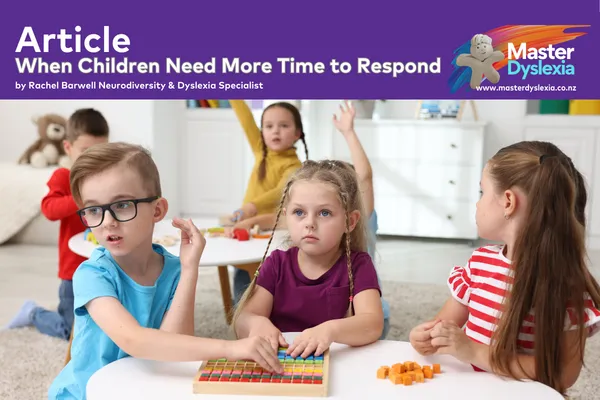
In many classrooms, quick answers are valued. A question is asked, hands go up, and responses come rapidly. For some children, this pace works well. For others, the moment passes before their thinking has had time to settle.
By the time they have processed the question, the conversation has already moved on. This can leave children feeling as though they are always a step behind—even when they understand the material deeply.
Thinking Often Happens Quietly
Not all thinking is visible. Some children respond immediately, speaking their thoughts as they form. Others process internally first. They listen carefully, turn the information over in their minds, and organize their understanding before speaking.
In my work with neurodivergent learners, I often compare this to the "Apple Mac vs. PC" reality. A "PC" brain might process simple text quickly, but an "Apple Mac" brain is often processing high-definition, 3D imagery. It’s a more complex "file," and it simply takes longer to load.
This is not a lack of ability; it is a different rhythm of thinking.
The 5 Steps of Processing
Learning relies on a series of mental gears turning in sequence. A child must:
Hear the question clearly.
Interpret what is being asked.
Search their memory for relevant knowledge.
Organize that information into a coherent thought.
Decide how to express it verbally.
For some learners, these steps happen in a flash. For others, they unfold more gradually. Neither approach is "wrong," but when speed becomes the only measure of success, the deep thinker begins to doubt themselves.
Why Speed Pressure Narrows Access
When responses are expected immediately, children who think more deeply feel the "urgency" we discussed in previous weeks. This pressure shifts the nervous system into protection mode.
When a child is in protection mode, their "access" to their knowledge narrows. They may stay silent rather than risk saying the wrong thing, or they may simply "blank." Over time, this creates the false impression that they do not know the answer.
The Power of the Pause
Sometimes the most helpful change is also the simplest: The Pause.
A moment to let the question settle. A little space for thinking to unfold. When children are given time, they are able to access ideas that would otherwise remain unspoken.
Instead of asking: "Why didn't they answer?" Try asking: "Did they have enough time to think?"
Take the Next Step: Understanding the Deep-Thinking Brain
If you notice your child struggles to find words under pressure or seems to "lag" in fast-paced conversations, they may be a highly visual-spatial learner.
To help you navigate these different rhythms, I’ve created a narrated guide: “How to Resolve the Top 5 Signs of Dyslexia”. I dive deeper into how "Energy Management" and "Perceptual Clarity" affect how quickly a child can respond.
👉 Download and Listen to the Narrated Guide Here
