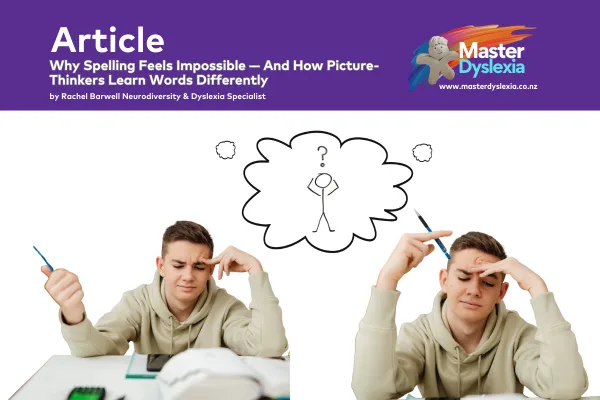
Why Spelling Feels Impossible, And How Picture-Thinkers Learn Words Differently
Why Spelling Feels Impossible, And How Picture-Thinkers Learn Words Differently
For many parents, spelling is the part of dyslexia that cuts deepest.
You watch your child try so hard to remember a simple word, sometimes one they’ve seen a hundred times, and yet the letters still tumble out in the wrong order. They might spell it one way today, a completely different way tomorrow, and feel utterly defeated by both attempts.
It’s heartbreaking, because from the outside it looks like the child “should” know it by now.
But inside their mind, something very different is happening.
And it has nothing to do with effort or intelligence.
When the Letters Don’t Match the Mind
Spelling challenges are one of the clearest signs of dyslexia. In the Master Dyslexia eBook, How to Resolve the Top Five Signs of Dyslexia, it’s listed as Sign 2: Struggling to Spell Common Words, right alongside the description of how abstract words can create confusion for picture-thinkers, because they simply don’t come with mental images.
Dyslexic learners aren’t storing words the way schools typically expect them to. They’re not building words sound by sound, or holding long strings of letters in their working memory. Instead, their brains instinctively reach for meaning, for imagery, connections, real-world experiences. When a word fits into that way of thinking, it becomes clear. When it doesn’t, the brain simply can’t hold onto it.
That’s why they can understand a word perfectly… but still struggle to spell it.
The Confusion Behind “Simple Words”
Many of the words children stumble over most, was, then, them, and, but, look small and harmless on the page. But to a dyslexic learner, they’re almost invisible. Their brain is searching for a picture, a concept, a scene it can grasp… and there’s nothing there.
The eBook puts this beautifully:
“They can register as blanks or confusion for dyslexic learners, and result in a lot of spelling and reading errors.”
And then there are homophones, the words that all sound the same but mean entirely different things. to / too / two. their / there / they’re. These aren’t just tricky. They’re exhausting. If your mind learns through meaning rather than sound, then identical-sounding words that refer to completely different ideas, and are spelled slightly differently, are a constant trap.
It’s no wonder spelling feels so overwhelming.
When Memorisation Fails
Traditionally, spelling has been taught through:
sounding-out
repetition
memorisation.
But this relies on a linear, auditory learning style, the exact opposite of how dyslexic thinkers process information.
This is why your child can study a spelling list all week, get every word right in the Friday test, and forget half of them by Monday. Their brain never understood those words in a way that made sense to them. They were memorised, not mastered.
And memorised learning always fades.
The Moment Everything Starts to Make Sense
The turning point comes when spelling stops being about “remembering the letters” and starts being about understanding the word.
When a child knows:
what the word actually means
what picture or feeling connects to it
how it fits into their world
…their brain suddenly has something to hold onto.
Meaning is what anchors the letters.
Meaning is what dyslexic minds rely on.
Meaning is what makes spelling possible.
This is why, in the eBook’s strategies, the very first instruction is:
“Look up the difficult word… The meaning is what makes the word come alive and be memorable.”
Once a word has meaning, spelling stops being a guessing game and becomes a kind of logic, a visual idea to recreate.
Hands-On Learning: Where Mastery Begins
Dyslexic thinkers learn beautifully through experience, movement, pictures, and real-world examples. When they can touch a concept, build it, see it, or explore it, the learning sticks.
A single list of spelling words on a worksheet might feel like torture.
But ask them to:
build the word in clay
illustrate its meaning
find it in the world
act it out
or connect it to a physical experience
…and suddenly their whole mind lights up.
This is the heart of the Davis approach.
This is where spelling stops being a wall and becomes a doorway.
You’ve seen this with Symbol Mastery, the moment a child sculpts a word, understands it, and owns it. The letters stop floating around. They settle into place. The confusion clears.
It’s the shift from memorising to mastering.
And once a child experiences that clarity, their confidence begins to rebuild itself.
A Child Who Feels Understood Learns Differently
Behind every spelling struggle is often a tired, discouraged child who is trying harder than anyone realises. They aren’t being careless. They aren’t being slow. They’re navigating an education system that speaks a different language to their brain.
When you begin teaching in their language, the language of meaning, imagery, and hands-on learning, the frustration melts away.
Your child doesn’t need endless drills.
They need understanding.
They need tools that match their thinking.
They need someone who knows how their mind works.
And that’s where real change begins.
A Way Forward
If your child is struggling with spelling, it doesn’t mean they’re falling behind. It means they’re being taught in a way their mind cannot use.
There is a better way, one that honours how they naturally think.
This is exactly what we teach in our programs and support sessions at Master Dyslexia. When you learn how to help your child build meaning, create mental images, and master words in a visual, tactile way, you unlock their potential, not just as a speller, but as a learner.
Because once spelling becomes clear, so does everything else.
To explore how this can help your child, you can book a free 30-minute chat at
masterdyslexia.co.nz
Link to ebook: https://masterdyslexia.co.nz/5topsignsdyslexiaebook
