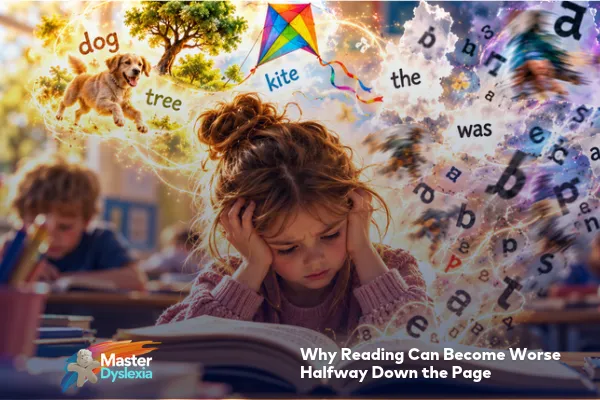
Why Reading Can Become Worse Halfway Down the Page: Dyslexia, Confusion and DisorientationNew Blog Post
At our WHO KNEW screening last Tuesday, a mum asked the question so many parents quietly carry: "My son's school says that he needs to learn twice as hard. Should he learn twice as hard, or learn differently?"
Ron Davis spent his life answering that question, and in his book 'The Gift of Dyslexia' he explained why the answer matters so much. It starts with a scene many parents know well.
A child sits down to read and starts out well, working through the first few lines carefully, even confidently. Then, somewhere around the middle of the page, things begin to slide.
Words get skipped or swapped. The same line gets read twice. A child who was doing fine a few minutes ago is now rubbing their eyes, fidgeting, or announcing that they're tired.
It's easy to read that as a child who has stopped trying. Ron saw something quite different.
In the first article in this series, I shared Ron's discovery that many dyslexic people are picture-thinkers, who think in images of meaning rather than in the sounds of words. Last week I looked at why small words like "the" and "was" cause them so much trouble: there's no picture for them. This week I want to explain what happens when those words start to add up, because it's the key to understanding why reading can get worse the longer a child keeps going.
How a picture-thinker builds meaning as they read
A verbal-thinker reads by hearing the words in their head, and the meaning comes together once the sentence is finished.
A picture-thinker builds the meaning as they go. Each new word adds something to the picture forming in their mind, and the picture grows in depth and detail as they read.
Ron explained that every time a word without a naturally occurring picture comes along, that process stops. In a sentence with several such words, the reader is left with what he called "a series of unrelated pictures with blank spots in between."
Imagine watching a film where the screen goes blank every few seconds. For a while you can piece the story together from the scenes you do see. But the more blanks there are, the harder it becomes to hold on to the plot, and the more effort it takes just to keep up.
The threshold of confusion
Ron described each of those stops as bringing a small feeling of confusion, as the picture becomes harder to make sense of.
A determined reader can push past the blanks with concentration, and many dyslexic children do, sometimes for years. But the confusion doesn't disappear when they push on. It accumulates, line by line, until the reader reaches what Ron called their threshold of confusion.
When confusion becomes disorientation
At that threshold, Ron explained, the reader becomes disoriented. Their perception of the symbols on the page shifts and becomes distorted, so that reading or writing becomes difficult or even impossible. Letters can seem to move around or flip. Lines can merge or jump.
This is why reading can get worse halfway down the page. The child hasn't stopped trying. If anything, they've been trying very hard, pushing through more and more confusion until their perception gives way.
It's also why more effort so often backfires. Hard work with the wrong method can make the problem worse, because every extra push adds more confusion on top of what's already there.
So to that mum's earlier question, my answer is to learn differently. When a child learns in a way that fits how they naturally think, their effort starts to pay off, and their confidence comes back with it.
The talent behind dyslexic disorientation
Here's the part of Ron's explanation I find most moving. The ability to shift perception isn't a fault or brain defect. Ron saw it as the same natural ability that helps a picture-thinker look at the world from many angles, recognising objects and making sense of their surroundings long before they ever learn to read.
"In some situations," he wrote, "the talent becomes a liability."
Ron knew this from the inside. As an adult, he learned to recognise his own disorientation and bring it under control, and that's what finally allowed him to read with ease.
Signs of disorientation to notice at home
Every child is different, but parents often recognise the signs once they know what to look for. A child might lose their place, skip a line, or read a word correctly and then misread it a few lines later. Letters like b and d may swap around. Their reading might get slower and more muddled the longer they go.
The signs aren't always on the page, either. Yawning, rubbing eyes, fidgeting, sudden silliness or simply shutting down can all be signals that a child has reached their threshold.
When you notice reading start to slide, the most helpful thing is often to stop sooner rather than push on. Take a short break. Read the harder passages aloud to them so the story keeps moving. And if you can, notice which words came just before things fell apart. Often they're the small words with no picture. It can be helpful to talk about those words, and what they mean, until your child can 'see' what the word means and carry on reading.
How Davis mental tools help
In a Davis programme, learners are given mental tools that help them notice when they've become disoriented and enable them to bring their perception back to a calm, steady state. Many children feel the difference straight away.
Once a learner can do that, the confusion can melt away, and learning can restart. For many, it's the first time they've felt in charge of their own learning, and that does a great deal for their confidence.
Next week, in the last article in this series, I'll look at the other half of the Davis approach: clay modelling, and how it gives picture-thinkers a meaning-based image for the words that don't naturally have one.
See it for yourself: the last WHO KNEW online screening of 2026
If you'd like to see these ideas brought to life, join us this Tuesday for our last online screening of 2026 of WHO KNEW: Dyslexia is a Way of Thinking. The film follows dyslexic learners and the people who work with them, and shows dyslexia as a perceptual difference, a talent even, rather than a deficit.
For some at last Tuesday's screening, the film stirred up emotions from the past. One attendee wrote simply, "Wish we had known more years ago." Another, there for a family member, said, "This has been a total learning curve for me. I had no idea what dyslexia is really all about."
➤ Tuesday 20 October, 7:00pm NZT / 5:00pm Sydney / 4:00pm Brisbane
The evening includes the film, a short introduction to Davis Dyslexia solutions, including the Davis Parent Power - Dyslexia course, and a Q&A session to follow.
I'm co-hosting with my Davis colleagues Claire Ashmore and Nikki Palamountain, Davis Dyslexia Facilitators, on behalf of the Davis Pacific facilitator team.
Ngā mihi nui,
Rachel
