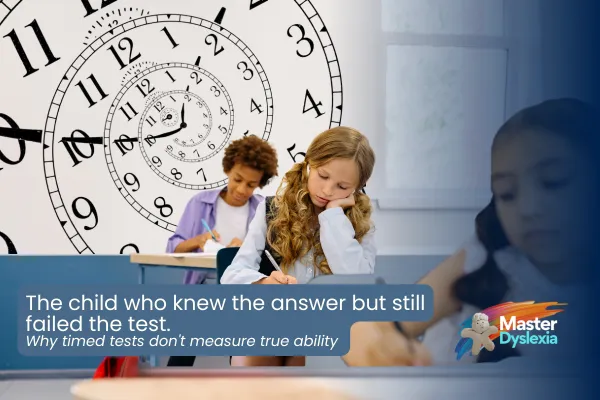
The Child Who Knew The Answer - But Still Failed The Test
The Moment That Changes Everything
There is a moment that quietly changes the way you see dyslexia.
It isn't when a child finally learns to read. It isn't when they receive a diagnosis.
It's when you realise they knew the answers all along.
Recently, during an international panel discussion on neurodiversity, one of our panellists, Geoffrey Ashiono, shared an observation that has stayed with me.
He described a student sitting a timed exam. There were twenty questions. The student answered only five before time ran out. Every one of those five answers was correct.
Yet the final mark recorded was 5 out of 20.
A fail.
Not because they didn't understand. Not because the content hadn't been learned. Simply because they ran out of time.
For any parent who has watched their child come home with a disappointing result — a result that bears no resemblance to what that child actually knows — that story will land somewhere deep. Because you have seen it. You have sat with your child at the kitchen table, heard them explain the concept perfectly, and wondered how on earth the test came back the way it did.
That gap between what a child knows and what a test records is not a mystery. It has a reason.
What Schools Often Measure
Most assessments don't simply measure knowledge. They also measure processing speed, working memory, the ability to organise thoughts under pressure, and the capacity to perform in conditions that are designed for a particular kind of thinker.
For many neurodivergent learners, these are the very areas that require the greatest effort. The result is that a bright child ends up believing they aren't capable.
Teachers see an incomplete paper. Parents see another disappointing report. The child sees evidence that everyone was right about them.
But often, none of those conclusions are true.
Intelligence Isn't Always Timed
This week I worked with a lovely young girl who found writing incredibly difficult.
If I had simply handed her a blank page and said "write me a story," she probably would have frozen. Not because she had no ideas. Because she had too many.
Instead, we slowed the process down. First, she chose a topic she cared about — her dog. Then we wrote individual ideas onto small notes. She physically arranged them into an order that made sense to her. Only then did we begin writing. One sentence at a time.
By the end of the session she had written a story she was genuinely proud of.
The words had always been there. What was missing wasn't intelligence. It was a process that matched the way her brain works.
We Often Reward Speed Instead of Thinking
Many dyslexic people tell me exactly the same thing.
"I knew the answer. I just couldn't get it onto the page. I ran out of time."
Others solve complex maths problems entirely in their heads but are marked down because they can't show every step in the conventional way. Their thinking and understanding are real. But our systems often reward the method more than the thinking behind it.
When that happens repeatedly, confidence slowly disappears.
The Hidden Cost
Over time, children begin to assume they're not smart. They stop volunteering answers. They avoid subjects they once enjoyed. Some become anxious or disruptive. Some simply give up.
Yet underneath all of that is often a child whose intelligence has never been properly recognised.
And the hardest part for parents? Watching it happen. Knowing your child is capable. Seeing them shrink. Hearing them say things about themselves that break your heart — and not knowing how to reach them across that gap.
It's worth asking ourselves a harder question: are we measuring what children know, or simply how quickly they can show us what they know?
Those are not the same thing.
Looking Beyond the Score
One of the most rewarding parts of my work is watching families realise that their child's struggles are not a reflection of their potential.
When we understand how a neurodivergent brain processes information, we stop asking "what's wrong with this child?" and begin asking "what does this child need in order to perform at their best?"
That is where real change begins. Not by lowering expectations. But by removing unnecessary barriers.
Because some of our brightest thinkers aren't failing. They're simply being measured in ways that don't allow them to demonstrate what they're capable of.
If this resonates — whether you're a parent who has watched your child struggle through assessments that don't reflect what they know, or a teacher looking for a better way — I'd love to hear from you.
Email me directly: [email protected]
