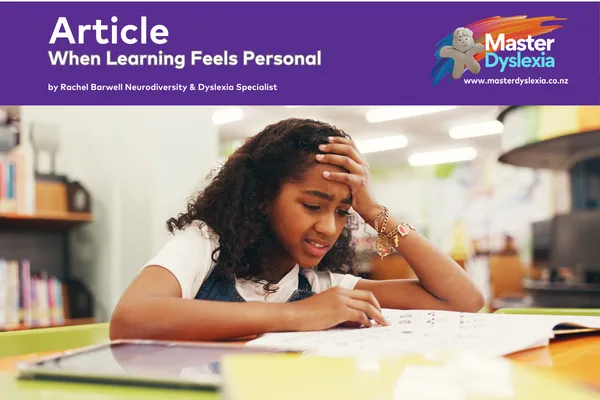
When Learning Feels Personal: Navigating Emotional Collapse in ADHD & Dyslexia
Some children don’t just struggle with learning.
They struggle with what learning means.
A spelling mistake isn’t simply a mistake.
A reading task isn’t simply a task.
A correction isn’t simply feedback.
For some learners, every challenge can feel like evidence.
Evidence that they’re behind.
Evidence that they’re not good enough.
Evidence that they’re failing, even when they’re trying.
This is often the moment parents begin to notice something deeper than academics.
Learning has started to feel personal.
Why Does My Child Meltdown Over Homework? When Feedback Feels Like Criticism
Most children can tolerate correction when they feel safe.
They can separate the task from their identity.
But when learning has been hard over time, that separation becomes fragile.
A child who has repeatedly experienced difficulty may begin to interpret feedback as judgment.
Not because they are overly sensitive.
But because they have been carrying effort for a long time.
Eventually, even gentle guidance can feel like another reminder of what isn’t working.
Why Confidence Can Collapse So Quickly
Parents often describe sudden emotional reactions that seem disproportionate to the moment.
Tears over a small mistake.
Anger at a simple instruction.
Avoidance after one correction.
It can be confusing.
But these reactions are rarely about the single moment in front of you.
They are often the result of accumulated experiences.
A child may have been holding it together all day, working hard, masking frustration, pushing through uncertainty.
Then one small trigger lands on a system that is already stretched.
And the response becomes bigger than expected.
ADHD and School Anxiety: The Hidden Story Children Begin to Tell Themselves
Over time, children develop stories about learning.
Stories like:
“I always get it wrong.”
“I’m not good at this.”
“Everyone else finds this easy.”
“There’s no point trying.”
These beliefs don’t appear overnight.
They are shaped gradually, through repetition.
And once they take hold, they influence everything.
A child may stop taking risks.
They may avoid tasks they previously enjoyed.
They may withdraw, rush, or resist.
Not because they don’t care.
But because learning has become emotionally unsafe.
Why Safety Matters More Than Motivation
"Motivation isn't the missing piece. Safety is."
When learning feels personal, motivation isn’t the missing piece.
A child who expects to fail will naturally protect themselves.
Sometimes that protection looks like avoidance.
Sometimes it looks like perfectionism.
Sometimes it looks like humour, distraction, or anger.
But underneath it is often the same need:
To avoid shame.
To avoid disappointment.
To avoid feeling exposed.
The Power of Being Understood
One of the most significant shifts for families happens when the child feels understood.
Not corrected.
Not compared.
Not pushed.
Understood.
This doesn’t mean lowering expectations.
It means shifting the emotional tone around learning.
When a child senses that adults are on their side, even in difficulty, learning becomes less threatening.
Mistakes become less loaded.
Effort becomes safer.
And confidence begins to rebuild.
Quietly.
Moving Forward Without Pressure
For many children, the turning point isn’t a new worksheet or a stricter routine.
It’s a change in the experience of learning.
A calmer pace.
A clearer starting point.
More predictability.
Less emotional weight attached to performance.
When learning stops feeling like a test of worth, children often begin to re-engage.
Not perfectly.
Not immediately.
But more willingly.
More steadily.
And with less fear.
When Learning Stops Defining Them
The goal isn’t for learning to become effortless.
The goal is for learning to stop feeling personal.
To stop feeling like proof.
To stop shaping identity through struggle.
Because children are not their mistakes.
And they are not their hardest days.
They are learners, and learning is something they deserve to experience with safety, dignity, and hope.
FAQ:
Q: What is an emotional collapse in learning?
A: It is a disproportionate emotional response—like anger or tears—to a small academic challenge, often caused by the accumulated stress of ADHD or Dyslexia.
If this cycle of emotional collapse sounds familiar, you don't have to navigate it alone.
We specialize in building the cognitive 'safety' and tools that allow learning to become steady again.
Let's find your child's safe harbour. Book Your Free Discovery Chat
