Crash, Click, Play Again
Why real-world consequence matters for people with ADHD who love gaming
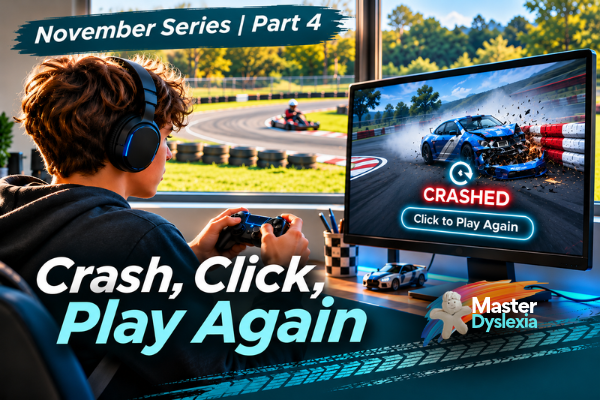
In an online racing game, you take a corner too fast, the car spins into a wall and you crash and die. You click a button and get to play again. Nothing is broken, and no one really gets hurt or dies.
On a real road, there’s no restart button.
That contrast came up last week in my conversation with Stephen Harrison on the Neurodivergence Matters podcast, and it’s the thread I promised to pick up this week. Many of the young people I work with who have ADHD are keen gamers, and so are plenty of adults. Gaming is fun, and some young people are remarkably skilled at it. But it can leave a real-world experience gap that matters a great deal as they grow up.
The boy who knew all about drift racing
A 14-year-old client of mine was fascinated by drift-car racing, and spent hours racing online. He could talk at length about cars and the technique of sliding sideways through a corner at speed. He’d already changed schools once because he’d lost interest in learning, and reading and writing were still a real struggle for him.
In the online racing game, he was an expert. Yet he’s too young to drive, so none of that knowledge had ever been tested in real life. He had no feel for the weight of a car, or how long it takes to stop on a wet road.
We built his Davis programme around his passion. One of the pieces he read was a short story about Luca, a boy who practised drifting on his PlayStation every night. Luca’s uncle, a former drift racer, takes him to a real event and says, “You’ll learn more there than any game can teach you.” When Luca finally gets behind the wheel of a training car, his heart is thudding, the car kicks sideways, and he nearly spins out. He gets it wrong many times before he gets it right.
That was the moment something shifted for my client. Reading about Luca’s first time on the track, he realised how different a real car would be from his controller, and that on a track or road, he’d be a beginner too. We also had many conversations about the real-world consequences of losing focus, or over-estimating one’s abilities when driving. Since he completed his programme, his family have told me his school results have improved dramatically, and he’s far more engaged in class.
What I mean by consequence
When I talk about consequence, I don’t mean punishment. As I said to Stephen:
“I mean, if you do something, something else will happen, and if you don’t do something, something else will happen. And we have a say in that world of consequence, if we choose to take it on.”
Many young people with ADHD don’t yet have a strong grounding in real-world consequence. It isn’t laziness, and it isn’t a character flaw. It’s a concept that hasn’t been fully experienced and integrated in their minds and lives yet.
Parents often see challenges with grasping real-world consequences in the homework left until Sunday night, or the “I didn’t think” after something goes wrong. The natural parental response is more reminders and tighter rules. That’s hard work for everyone, and it can make things worse. It can imply young people are irresponsible, or refusing to do the right thing, rather than recognising that an understanding of real-world consequence hasn’t yet been fully integrated in their thinking.
Why ADHD and gaming can be a tricky mix
Gaming often goes hand in hand with ADHD. It’s a very compelling activity, and that’s by design. I’ve read research showing that companies who design online games study psychology closely, to learn how to keep a brain engaged for as long as possible. The longer someone plays and stays on their platform, the more money the company makes, but this can often be at the cost of players’ wellbeing.
A game also offers instant feedback and unlimited second chances. Real life runs on a slower clock, where the results of a choice may not show up until days or weeks later, and where some things can’t be undone.
I’m not against gaming. But it’s worth being mindful of how much of a young person’s experience comes from a world where decisions and actions don’t have a lasting impact.
Building the concept, by hand
In a Davis℠ Mastery for Attention programme, we build on the Davis focus tools and use clay modelling to master the interlinking concepts of self, change, consequence, time, sequence and creating order. A young person models what happens when one thing causes something else to happen, then connects it to situations in their own life.
That hands-on work makes conceptual ideas concrete. Once a concept is anchored in reality, a young person can start to see the likely results of their actions further ahead, and make considered choices. That’s the “say” in the world of consequence I talked about with Stephen.
More of real life
I often encourage young people who spend a lot of time online to make sure they have other things going on in their lives. Activities in the real, tangible world give the brain something a screen can’t: the feel of real effort, and the satisfaction of real results.
For a young racing fan, that might be a day at the go-kart track, or helping to fix a motorbike or car. For an older teen heading into a demanding tech career, it might mean building a sustainable and healthy lifestyle now that doesn’t depend on burning the candle at both ends.
I know this from the inside. Before I understood my ADHD, I regularly pulled all-nighters to meet deadlines. The next day I couldn’t think or speak coherently, and over the years I lived with constant tiredness and a foggy brain. In my 40s, it caught up with me as a serious burnout that took a long time to recover from. No one warned me about that consequence, and I wish they had.
If you'd like to hear more, you can listen to our conversation, with the full transcript, from about 23 minutes in. It's also on Spotify and Apple Podcasts.
Next week
Next week is the final part of this series: maths and time. I’ll share my own story of failing 7th form algebra, and why a Davis Mastery for Maths programme can be ideal over the summer holidays.
Talk it through
If your child’s world feels more real on a screen than off it, a short conversation is an easy place to start. We can talk about what you’re noticing, and whether Davis Mastery for Attention or another Davis programme might suit your child, or you.
Ngā mihi nui,
Rachel
