Clay Modelling for Dyslexia: The Three Parts of a Word
Ron Davis was working as a sculptor when, in 1980, he made the discoveries that
shaped the rest of his life. So perhaps it's fitting that one of the most effective tools he
left us involves the creativity and simplicity of modelling clay.
This is the last article in my October series for Dyslexia Awareness Month, drawing on
Ron's first book, 'The Gift of Dyslexia'. In the first article in this series, I shared Ron's
discovery that many dyslexic people are picture-thinkers. Earlier this month I looked
at why small words with no picture, like "the" and "was", cause them so much trouble.
In my last article, I explained how the confusion from those words can build until a
reader becomes disoriented and can't interpret text any longer.
This article is about how clay modelling of words helps cement the meaning and
recall of words for picture-thinkers.
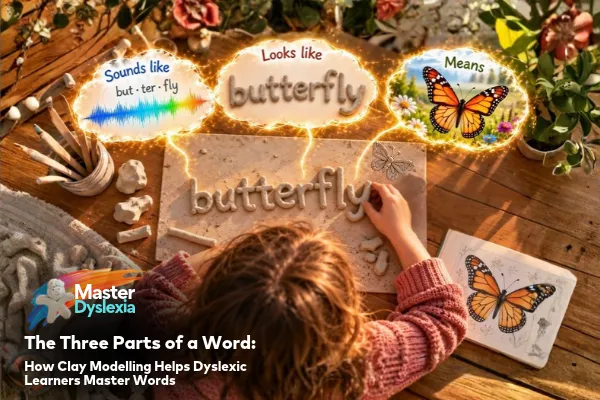
Every word has three parts
Ron described every word as having three parts: what it sounds like, what it looks like,
and what it means.
A verbal-thinker can manage reasonably well with the sound and the look of words.
They hear the word in their head, recognise its shape on the page, and let the
meaning of the sentence carry them along.
For a picture-thinker, meaning is the part that matters most, because meaning is
what they think with. A word like "elephant" arrives with its meaning ready-made.
Seeing the picture is seeing the meaning
A word like "the" or "because" is different. A child may know exactly how it sounds and
what it looks like, and still have no picture for what it means. Two parts of the word
are there, but the third is missing, and the missing part is the one a picture-thinker
needs.
That's why sounds-based spelling drills so often fall short. They keep strengthening
the two parts of a word the child already has, and leave out the meaning part, which
gives the visual understanding and recall for a picture-thinker.
How clay modelling works for dyslexia
Davis clay modelling of non-picture words fills that visual-meaning gap.
The learner makes a model showing what the word means in clay. Then they make a
model of how the word is spelled, and place the two together. With the word "big", for
example, a child might model the letters b-i-g beside a big clay dog and a little one,
so the meaning sits right next to the word.
At that point all three parts come together: the sound they say aloud, the look of the
letters they've shaped, and the meaning they've created with their own hands. For a
picture-thinker, the word finally has a visual meaning.
The small, abstract words take more thought to model, and a facilitator or trained
parent guides that process. But the principle is the same. Rather than memorising a
word they can't picture, the child creates its meaning, and once a word has been
mastered this way, it tends to remain in their visual memory for the long term.
It's also why clay modelling and the mental tools I described in my last article work
so well together. The mental tools help a learner stay oriented and calm. Clay
modelling removes the source of the confusion, one word at a time.
Why mastering a word builds confidence
Something happens to children when they master a word they've stumbled over for
years. The word that once made them feel stupid becomes one they created and
mastered themselves, and that changes how they see their own mind and
capabilities. They develop pride in themselves and their work.
In my work, that shift in confidence comes first. Progress with reading and spelling
tends to rapidly follow, as the child sees, "I CAN do this after all."
Ron put it simply: "The gift is always there, even if it isn't recognised for what it is."
For the young ones coming through
This October began with Ron as a small boy in a classroom corner, praying not to be
sent there again. He spent the rest of his life making sure the "young ones coming
through" wouldn't have to sit in that corner.
The people best placed to carry that work forward are often the adults closest to a
child. That's why the Davis Parent Power - Dyslexia course exists: to put these tools
into the hands of parents and educators, so the child in front of them can be
understood and supported as a dyslexic learner, rather than corrected.
Over six live online sessions, you learn Davis mental tools for calm, steady focus, and
Davis clay modelling for mastering the words that keep tripping a child up. No prior
knowledge is needed, and session recordings are available if you miss one.
Six live sessions on Sundays: 1, 8, 15, 22, 29 November and 6 December
1-3pm NZT / 11am-1pm Sydney / 10am-12pm Brisbane, live on Zoom
Register by Sunday 25 October to receive a complimentary 45-minute Explore
Dyslexia Solutions consultation, and your course materials in time for session one.
Registration closes on Saturday 31 October.
Presented by Rachel Barwell, Claire Ashmore and Nikki Palamountain, Davis Dyslexia
Facilitators, on behalf of the Davis Pacific facilitator team.
➤ Register for the Davis Parent Power - Dyslexia course
Ngā mihi nui,
Rachel
