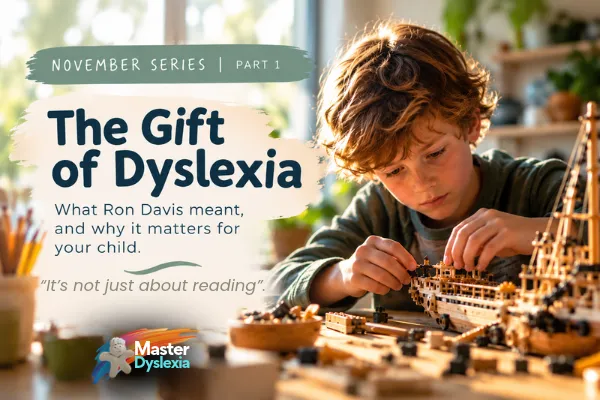
The Gift of Dyslexia: What Ron Davis Really Meant by It
For October Dyslexia Awareness month, I spent four weeks unpacking Ron Davis's explanation of what happens when a picture-thinking mind meets the printed word. We looked at the small words with no picture, the confusion they cause, and the disorientation that can follow. We finished with clay modelling, the tool that gives those words a meaning a picture-thinker can grasp and remember.
All of that was about the struggle, and how to ease it. This month I'd like to turn the picture around.
Ron called his first book 'The Gift of Dyslexia', and he meant the title literally. It can sound like a kind phrase offered to soften a hard diagnosis. That isn't how he used the word ‘gift’.
The struggle and the gift come from the same place
Ron's central idea was that the set of perceptual abilities which makes reading so hard for a dyslexic learner is the same function that gives them their talents. They aren't two separate things that happen to sit side by side in one person. They're one set of abilities, showing up differently depending on what they're applied to. As Ron put it, "Dyslexia is the result of a perceptual talent."
Point it at a page of print, and a picture-thinker's mind can shift its perspective, try to make sense of a symbol from several angles at once, and end up disoriented and confused. Point the same mind at a broken engine, a story or a friend who is upset, and that ability to move around a problem and see it from the inside can look a lot like brilliance.
What Ron saw in dyslexic minds
In 'The Gift of Dyslexia', Ron describes the basic abilities he found dyslexic people share. Picture-thinkers, he wrote, tend to be highly aware of their surroundings and more curious than average. They think mainly in images rather than words, and they perceive multi-dimensionally, drawing on all their senses at once. Many are highly intuitive and insightful, with vivid imaginations, and they can experience a thought so fully that it feels real.
Underneath all of these sits the talent Ron considered the primary ability: the brain's capacity to alter and create perceptions. It's what lets a picture-thinker walk around an idea in their mind's eye. It's also, as we saw last month, what makes an unfamiliar word on a page so slippery.
Ron believed that if these abilities aren't suppressed or invalidated, at home or at school, they tend to develop into higher-than-average intelligence and extraordinary creative ability. From there, he wrote, the true gift of dyslexia can emerge, which he called the gift of mastery. For one person it shows up in science, for another in art or sport.
Why words like "if" matter so much
Many of the children and adults I work with arrive having spent years hearing about what they can't do. The abilities Ron described are usually still there, but they're buried under a story about being slow, lazy or stupid.
The gift doesn't disappear when a child struggles at school. What tends to fade is the child's belief that there's anything good about the way they think.
That's why, in my work, confidence comes first. When a learner understands that the mind which trips over "if" is the same mind that can build and imagine extraordinary things, something shifts. Progress with reading and spelling tends to follow once they stop seeing their own thinking as the problem.
Signs of the gift of dyslexia you might notice at home
A picture-thinker's gifts often show up in different situations.
You might notice your child can rebuild something from memory after seeing it once, or can spot a change in a room before anyone else does. Some can lose themselves for hours in drawing, building or a game world, yet drift off within minutes of seeing a worksheet. Others read people remarkably well and seem to know how someone is feeling before a word is said.
On their own, these aren't a confirmation of dyslexia. But if you're seeing them alongside a struggle with reading, spelling or focus, it's worth looking at the struggle through Ron's lens of giftedness, rather than as a lack of effort by the person.
Not just reading
Ron noted that reading, writing, spelling and maths are only the most common places dyslexia shows up, and that there are many other places. When a picture-thinker's perception shifts, it isn't only what they see that changes. Their sense of balance and movement, and even their sense of time, can shift with it. So, the same way of thinking can show up as trouble with attention, with handwriting and coordination, or with maths and time.
Over the coming weeks I'll look at these challenges through the lens of Ron’s work, alongside the Davis programmes designed for each. Next week is attention, and why a child who seems not to be listening may simply be internally preoccupied with their imagination.
A new group began today
Today our November Davis Parent Power - Dyslexia course began, with a new group of parents and educators learning Davis tools for themselves, to share with their young people. A warm welcome to everyone who joined us. It's a privilege to share Ron's work with you over the next six weeks.
If you'd hoped to join and missed the start, there's still time. Session one is recorded and its materials can be sent to you electronically, so you can catch up and join us live from session two on Sunday 8 November.
Sundays, 8 November to 6 December
1-3pm NZT / 11am-1pm Sydney / 10am-12pm Brisbane, live on Zoom
Presented by Rachel Barwell, Claire Ashmore and Nikki Palamountain, Davis Dyslexia Facilitators, on behalf of the Davis Pacific facilitator team.
One-to-one support
If you'd rather explore one-to-one support for your child, or for yourself, my Mastery for Dyslexia programme is built around the unique ways each person thinks, and around what they are interested in. A short conversation is the easiest place to start.
Ngā mihi nui,
Rachel
